2026 CFO Playbook
CFO confidence hits a 4-year high. Here are 5 moves CFOs must make to change the finance function.
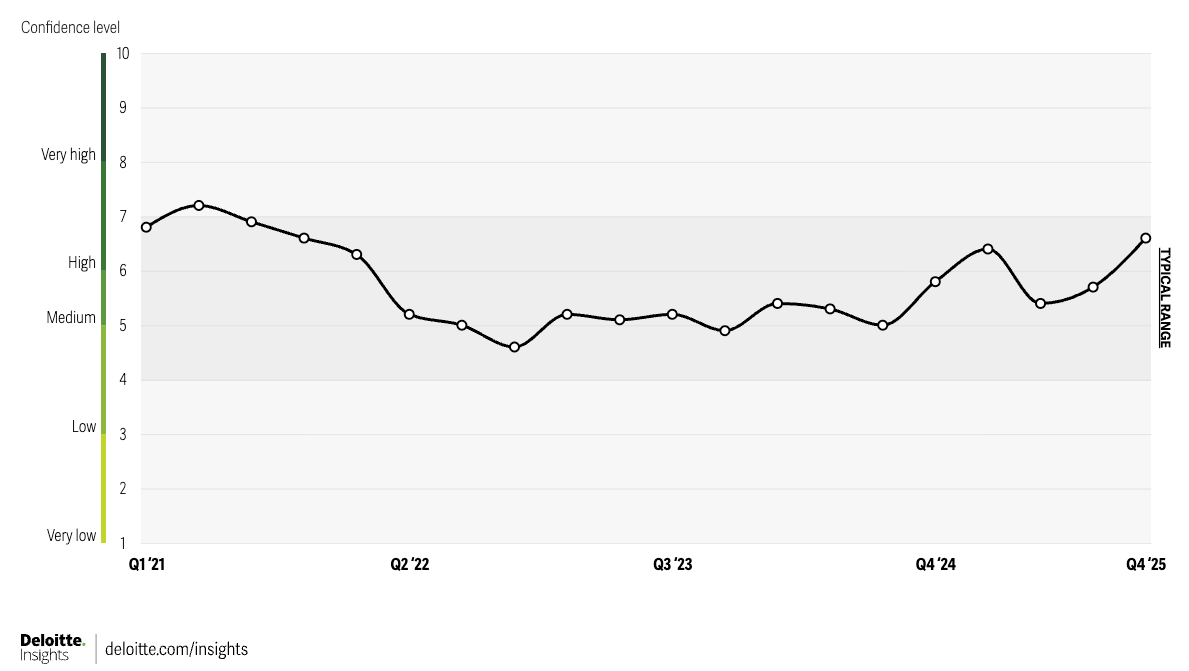
CFO confidence hits a 4-year high.
Historically, this is not when finance errors disappear.
It is when they become more expensive.
You can feel it already.
The CEO wants confidence.
The board wants momentum again.
The numbers look stable enough to relax.
And the market is rewarding companies that sound certain.
That’s exactly why 2026 is dangerous.
Misallocation becomes easy.
When confidence rises, companies spend faster than they think.
They hire ahead of reality. They fund too many initiatives. They approve tools that should pay off without demanding proof. They mistake activity for progress because the mood improves.
Most CFOs will enter 2026 thinking the job is to plan harder.
The job is not to plan harder. The job is to build a finance operating system that can reallocate resources without drama.
That is what separates a CFO who manages the numbers from a CFO who quietly becomes the most important decision-maker in the company.
This is the year your value stops being measured by accuracy and starts being measured by speed, discipline, and judgment.
Read on.
2026 is Not About More AI
A lot of finance teams are about to do the wrong work at the highest intensity.
They’ll tighten close.
They’ll buy AI features.
They’ll upgrade dashboards.
They’ll add scenario tabs to the model.
And decisions will still be slow.
The constraint is decision bandwidth.
You already have more data than your executive team can metabolize.
Your challenge isn’t generating insight.
It’s turning insight into action before the environment changes again.
That requires finance as resource orchestration.
Don’t just explain what happened.
You must shape what happens next.
A huge portion of AI in the CFO office is cosmetic right now.
It writes summaries.
It drafts narratives.
It answers questions.
It produces first-pass analysis.
Useful, sure. But none of that changes the board’s real question:
“So what should we do?”
In 2026, the AI conversation shifts from novelty to accountability.
When the finance function tells the company it’s deploying AI, the business expects one of 3 outcomes:
Faster execution (cycle time drops)
Better economics (margin or cash improves)
Fewer errors and less risk (auditability increases)
If you can’t point to one of those changes, your AI program becomes a cost line item with a nice story. This is why the next phase isn’t more AI.
It’s AI with measurement.
And the reason that’s hard is simple:
AI doesn’t fail in finance because the model is weak.
It fails because the operating model is undefined.
If decision rights are unclear, if data ownership is messy, if workflows are inconsistent, AI becomes a layer of speed on top of confusion.
That doesn’t create leverage. It creates faster noise.
So the CFO job is to define the system first, then let AI accelerate it.
Focus on Fewer priorities, Deeper Execution
CFOs are being pulled in every direction.
Boards want growth.
Talent remains tight.
Regulation doesn’t relax.
External volatility doesn’t go away.
Cost discipline remains non-negotiable.
Most CFOs respond by trying to do everything. Top CFOs respond by building a machine that can handle competing priorities without collapsing.
This playbook is that machine.
It is built on five moves.
Yes, moves.
Each move changes how your finance function behaves under pressure.
1) Replace the annual budget with conditional commitment
The annual budget is not wrong.
It’s just structurally mismatched to how 2026 behaves.
Budgets assume a stable world where you can estimate demand, lock costs, and then manage variances. 2026 won’t break you with one giant shock.
It will break you with unevenness.
Demand doesn’t fall off a cliff. It shifts.
Margin doesn’t collapse. It erodes in pockets.
Costs don’t spike once. They creep through tools, contractors, and duplicated work.
When the pattern is uneven, the budget becomes a political document.
Every function fights for certainty. And the CFO becomes the referee.
What works better is a plan that behaves like capital allocation: staged, conditional, reversible. Here’s the practical change:
Instead of saying, “We will invest X this year,” you say:
“We will invest X if these signals hold. If they don’t, we shift to this action within 30 days.”
That one change does something profound.
It turns planning into a decision system.
It also gives your CEO and board the one thing they actually need in uncertainty:
Not certainty.
Preparedness.
Preparedness looks like triggers and pre-decisions.
So build 3 scenarios you can actually act on.
Not 12 that look impressive.
One scenario for demand shifting.
One scenario for margin pressure.
One scenario for execution not landing.
And for each: define the trigger, define the action, define thowner, andr, define the timing.
If it can’t be executed, it isn’t planning.
2) Build a reallocation cadence that the company can trust
Most CFOs believe they are slow because the data arrives late.
That’s partially true.
But the deeper truth is that companies are slow because decisions get trapped in process:
Ambiguity about who has authority.
Fear of being blamed for being wrong.
Approval loops that exist because of past mistakes.
Committees that exist because nobody wants ownership.
In 2026, speed is not move fast and break things.
Speed is move fast and stay auditable.
That requires governance designed for reality.
You don’t need more meetings.
You need fewer, clearer decision moments.
A simple cadence is usually enough:
A weekly operating signal review that flags drift early.
A monthly resource reallocation review that forces trade-offs.
A quarterly portfolio reset where you stop things aggressively.
The key is not frequency. The key is this:
When a decision is made, it actually sticks.
Top CFOs create decision integrity.
They remove the second-guessing loop that kills execution.
If your executives keep revisiting the same decisions, your problem isn’t analytics.
It’s governance design.
3) Treat cost as a discipline, not an event
The old cost model was cyclical.
Grow, lose control, cut; and repeat.
In 2026, cost becomes continuous because the business is continuously changing.
You cannot “cut once” and declare victory.
Costs hide in places CFOs used to ignore:
Tool sprawl.
Duplicate platforms.
Overlapping contractors.
Cloud spend without guardrails.
Shadow finance work inside functions
Manual processes that survive because nobody owns the redesign.
If you want cost discipline that doesn’t destroy momentum, you need 2 things:
Ownership.
A metric that shapes behavior.
Ownership means someone is accountable for cost outcomes, not just reporting.
And the metric cannot be vague.
A good productivity metric has three properties:
It is hard to game.
It is easy to compute.
It changes behavior without needing motivation.
For some businesses, that metric is gross profit per headcount.
For others, contribution per fully loaded employee.
For operational finance, cost per transaction in AP/AR/close.
The point is not the metric.
The point is that the company feels the constraint.
Because constraints drive quality.
If you want better economics in 2026, you need a constraint system that is visible and persistent, not an annual cost campaign.
4) Run AI like a CFO program: measured, governed
Here is the simplest way to stop AI from becoming a story:
Every AI initiative must land in one of four outcome buckets, with a number attached:
Speed (cycle time)
Economics (margin/cash)
Accuracy (error reduction)
Risk (auditability/compliance)
If an AI initiative cannot be measured in one of those outcomes, it’s not a finance initiative. It’s experimentation.
Experimentation is fine. But it should not be budgeted like transformation.
In 2026, you need to separate 3 categories:
AI convenience: makes things nicer (drafting, summarizing).
AI efficiency: saves hours and reduces process cost.
AI leverage: changes the decisions the business makes.
Most teams are stuck at convenience.
The money is in efficiency and leverage.
And here’s the part CFOs miss:
You don’t get leverage from AI without clean data ownership and process definition.
The road to Agentic systems isn’t magic. It’s boring.
Clear workflow definition.
Clear data stewardship.
Governance rules.
Permissioning.
Audit trails.
Build that, and you can safely automate more.
Skip it, and you create risk disguised as innovation.
AI in finance is not a software rollout.
It’s an operating model upgrade.
Move 5: Build the finance team that 2026 needs
Finance talent is being squeezed at both ends.
Traditional accounting supply is tightening in many markets.
Meanwhile, the role is absorbing responsibilities that look like product and engineering work:
Automation design.
Tooling governance.
Analytics integration.
Data infrastructure thinking.
Cross-functional operating cadence.
The finance team of 2026 is not more FP&A analysts.
It’s a blended organism:
Core accounting strength for integrity.
Analytics capability for decision support.
Finance systems capability for scalability.
Governance capability for speed with control.
This doesn’t mean you turn your finance team into engineers.
It means you stop pretending the modern CFO office can run without technical fluency. And it means you hire differently.
You don’t hire only for years of experience.
You hire for curiosity, systems thinking, and comfort with change.
Because the CFO office is becoming the place where the company learns to operate under uncertainty.
The Bottom Line
The elite CFO move in 2026 is time sovereignty.
You protect time for the only work that compounds:
Decision design.
Governance upgrades.
Capital allocation logic.
Talent and operating model design.
Scenario triggers and action readiness
This is how you become strategic without using the word “strategic” once. You build a system where fewer things require your attention, because the machine runs.
What actions are pre-approved under each condition?
What is the single productivity metric we will not allow to drift?
What are the three conditions that would force us to change course quickly?
Which decisions are currently slow because of governance and what rule will we remove first?
Which AI initiatives can prove value in economics, speed, accuracy, or risk and which will be shut down?
If you can answer those, you’re not preparing for 2026.
You’re already operating like it.
2026 will not reward the CFO who is best at explaining what happened.
It will reward the CFO who can make the CEO and the Board feel calm while making hard trade-offs early.
The CFOs must own the decision system.
Finance is the only function structurally positioned to do it.
And that’s all for today.
See you on Thursday!
Whenever you’re ready, there are 2 ways I can help you:
If you’re building an AI-powered CFO tech startup, I’d love to hear more and explore if it’s a fit for our investment portfolio.
I’m Wouter Born. A CFOTech investor, advisor, and founder of finstory.ai


