

Every expert is screaming that AI will change every role. But if you’re a CFO looking at your P&L, you’re probably asking: When?

The latest Duke CFO Survey warns a majority of CFOs are seeing zero AI impact on:
Labor productivity.
Customer satisfaction.
Decision-making speed.
Time spent on high-value work.
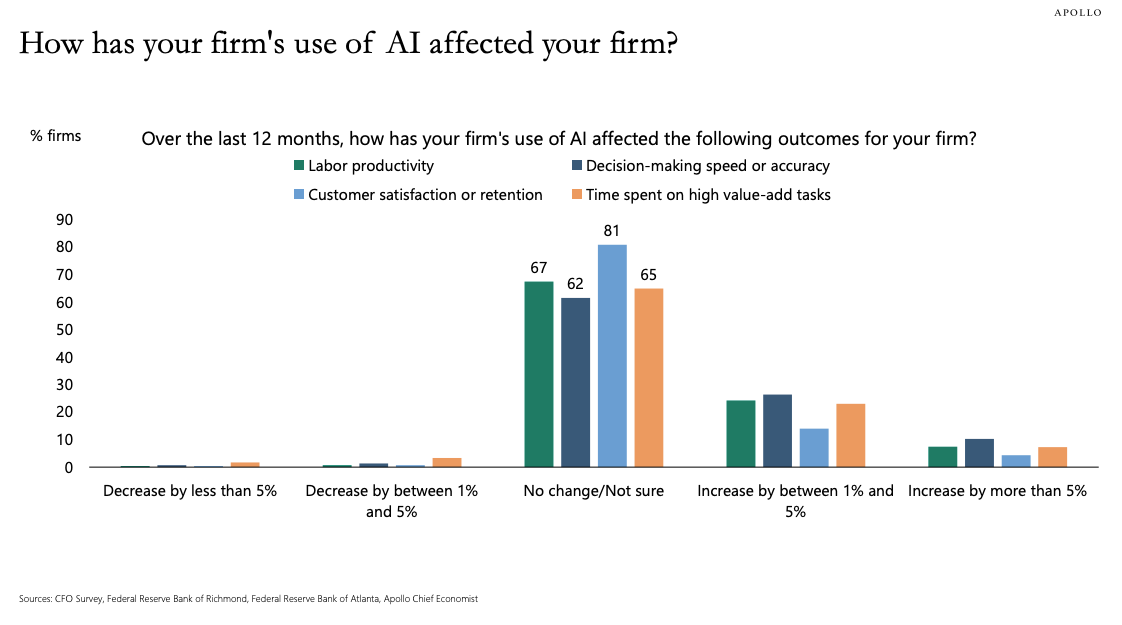
AI is on the balance sheet, but the value is missing. And MIT also published a study with a headline-grabbing stat: 95% of enterprise AI projects fail to deliver ROI.

That means for every success story, 19 projects fail. Burning budgets, wasting time, and leaving leadership wondering if AI is just hype. But inside the company, the truth is harsher:
Adoption stalls.
Workflows stay brittle.
Nobody trusts the output.
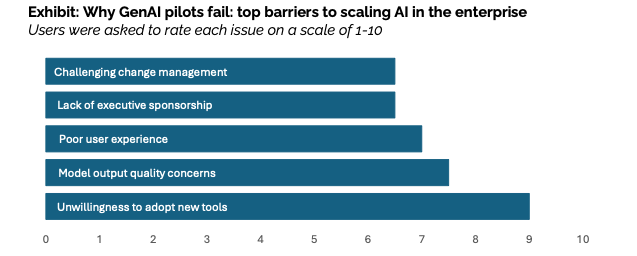
The pilot never scales. The project never leaves the lab. ROI never arrives.
To understand how AI is actually changing roles in the $18.6 trillion labor market, the market must be analyzed through a 3-layer framework: Exposure, Adoption, and Response. This model explains why different observers see different realities.
Some focus on what the tech can do, while others focus on what it is doing.
Let’s dive in.
The 3 Layers of the AI Labor Market
Layer 1: Exposure
Exposure answers a simple question: what could AI do today if we actually let it?
This wave of AI is not targeting factory floors or manual labor first. It’s targeting thinking work. The roles most exposed are not low-paid or repetitive. They are cognitive, non-routine roles we once assumed were safe. Financial analysis. Research. Writing. Planning. Judgment-heavy work near the top of the pay scale.
The irony is that the more education a role requires, the more exposed it often is.
But exposure does not mean displacement.
In fact, many of the most exposed roles have grown over the last five years. When AI boosts productivity, the firms that adopt it grow faster. And growing firms hire more people. AI doesn’t remove the role. It reshapes it.
Layer 2: Adoption
Adoption answers a very different question: what is AI actually doing inside real companies?
Here’s the gap. More than half of U.S. adults now use AI individually. But fewer than ten percent of businesses have integrated AI into their core operations. Most AI never touches production workflows. It sits on the surface.
Large firms move faster because they build AI into their own systems. Smaller firms lag because off-the-shelf tools don’t integrate with messy reality.
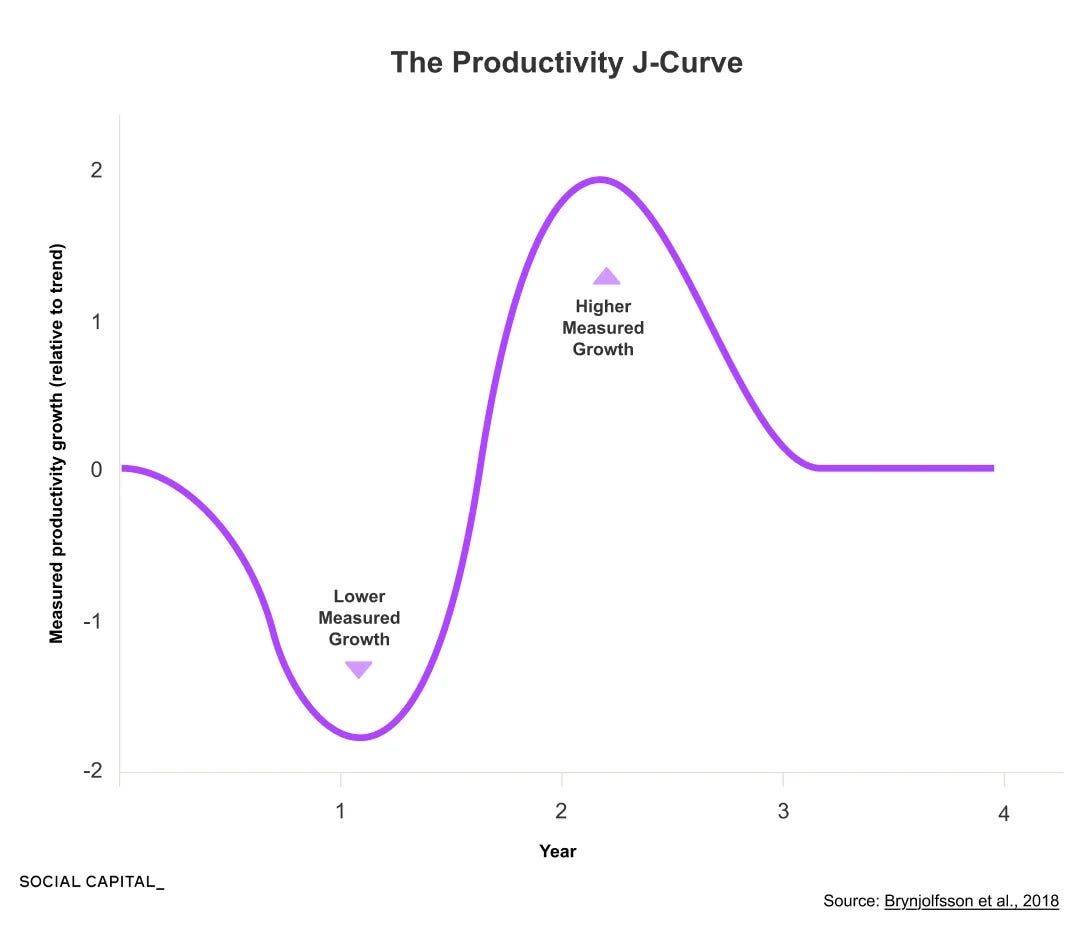
This gap between exposure and adoption is where the Productivity J-Curve lives. Productivity dips before it rises. Learning costs show up first. ROI disappears on paper. And that is exactly where most CFOs are stuck today.
Firms that adopt AI deeply tend to be larger, more productive, and able to pay higher wages. But they don’t feel the gains right away. Early on, learning costs dominate.
Teams slow down before they speed up. Productivity looks worse before it looks better. That’s why the payoff feels invisible at first, even when the long-term advantage is real.
Layer 3: Labor Market Response
The ultimate response of the labor market follows 3 distinct paths:
Augmentation: AI expands what a person can do by removing low-leverage work. The role doesn’t disappear. It stretches. Law is the clearest example. When AI absorbs research and document review, lawyers spend more time on judgment, strategy, and advocacy. Employment grows because firms become more productive and can take on more work.
Displacement: This happens at the task level, not the role level. Entry-level and narrow tasks are automated first. Hiring slows for highly exposed junior roles like entry-level coding and clerical work, not because the profession is dying, but because firms choose to buy capacity from agents instead of training humans to do repetitive work.
Reinstatement: New roles emerge that didn’t exist before. People who orchestrate agents. People who audit data lineage. People who manage how models and humans collaborate. Work doesn’t vanish. It reorganizes around the technology.
For the CFO, agentic AI forces a big shift in leadership style. The job moves away from being the technical expert who knows how the work is done. It moves toward becoming the Editor-in-Chief of the financial system.
The CFO defines the goals, sets the constraints, and reviews the output produced by a team of humans and agents working together.
The exponential growth of what AI can do
To understand why the ROI is lagging, you have to look at what exponential growth actually looks like in AI right now.
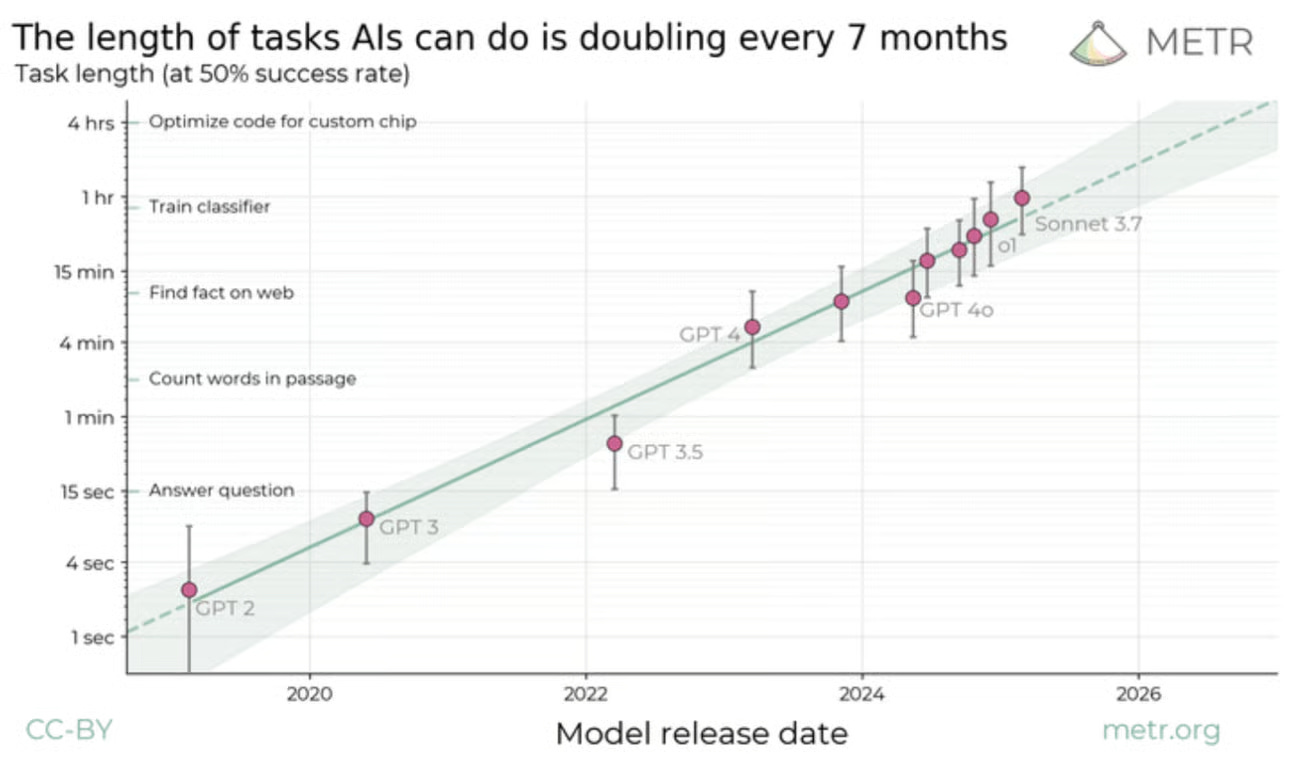
But METR is tracking something more relevant for CFOs.
The “time horizon” of AI agents. How long they can complete tasks autonomously. This is doubling about every ~7 months.
That matters because AI isn’t one thing.
There’s a massive difference between a model that answers questions and an agent that runs work for 45 minutes, catches its mistakes, and finishes the job.
METR’s framing measures AI by the length of tasks it can complete, not by how clever it sounds. And their results show a consistent exponential trend.
So we are moving from ideas to execution.
I covered this in my last newsletter about Claude Cowork.

You can read it now or later.
So why… do the majority of CFOs still not see the impact?
Let’s look at that gap.
The AI value gap (what’s actually broken inside companies)
If the models are improving exponentially… why does the ROI still flatline?
Most companies are stuck in the same failure mode.
1. They buy AI features, not AI workflows
They automate fragments. They generate answers. They draft narratives. But they don’t redesign the workflow end-to-end. so the AI sits on top of chaos… and produces beautiful output with weak foundations.
2. Finance has a higher bar than every other function
In marketing, mostly right can still win. In finance, mostly right is a disaster. CFOs want:
Controls.
Audit trails.
Permissions.
Explainability.
Accountability.
Exception handling.
Most AI deployments ignore that. So finance teams do the only rational thing. They don’t trust the output, and they keep the old process running in parallel.
That’s why CFOs report no impact. Because the AI is not allowed to touch the work that matters.
The real gap is operating system capability. AI doesn’t create value in finance by sounding smart. AI creates value when it can reliably do 4 things:
Ingest the real inputs (ERP, invoices, contracts, bank feeds, CRM)
Act inside the workflow (reconcile, classify, post, route, draft, escalate)
Explain what it did and why (controls + traceability)
Improve with feedback (so exceptions shrink over time)
Most companies are only doing #4 in PowerPoint.
They’re not doing #1–#3 in production.
That’s the gap.
What changes the CFO role when this finally works
So AGI (functionally) is the ability to figure things out and long-horizon agents are the turning point. That matters for CFOs because once agents can run workflows for longer stretches, finance stops using software and starts managing capacity.
When this works, the CFO role changes completely in 3 ways:
1) From reporting owner to exception owner
Your team won’t prepare reports. Agents will prepare them.
Humans will:
Sign off.
Drive decisions.
Review exceptions.
Challenge assumptions.
2) From cost center optimizer to decision velocity leader
When close compresses, forecasting updates faster, and variance explanations generate daily, finance becomes the function that speeds up the whole company.
You won’t do more analysis but decide faster.
3) From spreadsheet operator to governance architect
The CFO becomes the person who defines:
How to log actions.
What it cannot touch.
How to audit outcomes.
Where approval gates sit.
What the agent can touch.
In the AI era, governance becomes a competitive advantage.
And that’s all for today.
See you on Thursday!
♻️ Share what you’re reading with your friends.
Whenever you’re ready, there are 2 ways I can help you:
If you’re building an AI-powered CFO tech startup, I’d love to hear more and explore if it’s a fit for our investment portfolio.
I’m Wouter Born. A CFOTech investor, advisor, and founder of finstory.ai