Anthropic just shipped a finance department in a box and changed the CFO role
Oracle paid $29.7M for one CFO. Sarah Friar publicly disagreed with Sam Altman. And Anthropic's CFO built the architecture every CFO will copy by Q4.
Anthropic just shipped a finance department in a box.
They shipped 15 small business agents. 8 of them for finance.
Invoice chaser. Payroll planner. Month-end closer. Margin analyzer. Tax-season organizer. Contract reviewer. Lead triager. Content strategist. Campaign builder. Business pulse.
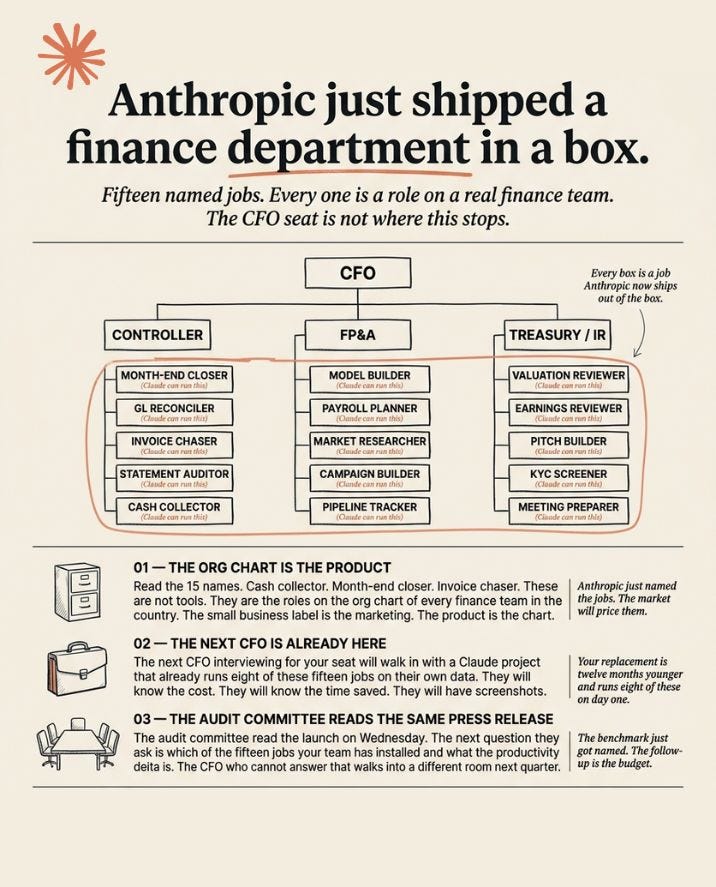
Each one is built the same way:
Skills, connectors, workflows.
Skills are the tasks. Connectors are the data. Workflows are the orchestration.
This is the same architecture I’ve been sharing with you in the last letters.
The CFO Skill Stack uses the exact three building blocks. Anthropic just made it the default for 36 million US small businesses.
Anthropic's CFO uses Claude for the monthly financial review
His team built a library of finance skills. Over 70 of them. They built one skill called MFR. The monthly financial review skill. In Krishna's own words:
"It can produce our monthly financial review. It's 90 to 95 percent ready and then all of our discussion becomes about what do we do, what are the implications, not what exactly happened. Because Claude is not just reporting the weather. It's also helping to think about drivers and why the number changed the way it did."
Krishna Rao runs finance for a company that went from $9 billion to over $30 billion in run rate revenue in four months.
The numbers are remarkable.
Statutory financial statements for every Anthropic legal entity are now produced with Claude. A human checks the output. Claude does the work. A weekly revenue or compute utilization report that used to take hours now takes 30 minutes.
That is what the closed-loop MFR looks like when it works.
The finance leader who treats Claude as a calculator is going to be sitting across from a finance leader who treats it as a reasoning engine.
I built the version of the MFR skill for every CFO.
The Closed Loop Finance Function
CFOs can use AI agents and the CFO Skill Stack to build an AI-native company without buying more AI tools. They need to run finance as a Closed Loop. AI improves when it gets feedback. Your finance function improves when it gets feedback. Both stop improving the moment the loop is open.
Most CFOs run an Open Loop. You decide. You execute. You don't measure the outcome. The variance to plan is a postmortem. The lesson dies in your inbox.
That is the operating system most finance functions still run in 2026. It worked in 1996. It even worked in 2016. It does not work now.
AI improves when it gets feedback. Your finance function improves when it gets feedback. Both stop improving the moment the loop is open.
A Closed Loop changes that.
Every decision produces an artifact. Every artifact is legible to AI. The system continuously monitors its output and adjusts.
Decide. Execute. Log. Measure. Learn. Improve.
This weekend I built one on a sample company.
Google Drive holds the evidence.
Close packs. Board decks. GL exports.
Notion holds the structured decision memory. Every material decision logged with date, owner, and category.
Claude Cowork is the operator. It reads the evidence. Pulls the memory. Drafts the close review. Writes new decisions back into Notion at the end of every session.
Most CFOs have 80% of their institutional knowledge sitting in a senior controller's head. That is an open loop. The CFO who builds a closed loop captures it before that controller retires.
The CFO running an open loop is replaceable.
The CFO running a closed loop is not.
The most important CFO story of the year
OpenAI’s CFO Sarah Friar is fighting Sam Altman over how much money OpenAI is spending on AI.
The CFO of the company that built ChatGPT is worried the company is spending too much on data centers and is not generating enough revenue to justify the contracts she has signed.
She wants discipline. He wants scale.
Every CFO is living a smaller version of this exact fight inside their own company right now. The CEO sees AI as the future and wants to spend. The CFO sees the contracts, the burn, and the lack of measurable return.
And the board is watching both.
Friar's job is the hardest CFO job on Earth this quarter. She is funding a buildout that her CEO believes in faster than her balance sheet can defend while preparing the company for an IPO that will price every dollar of unproven AI capex.
Three lessons from how Friar is handling it.
She is not pretending the math works.
She is publicly disagreeing with the CEO. That is the discipline finance is supposed to bring. She is asking for accountability on the contracts she signed.
Every CFO with an AI budget must do the same.
What did we sign for?
What are we using?
What is it producing?
She is preparing the S-1 anyway.
Internal disagreement does not pause the work.
The IPO clock keeps moving.
The Bottom Line
CFOs must stop seeing AI as a tool and start using AI as an operating system. Let every workflow, every decision, every process flow through an intelligent layer that learns and improves on its own.
Oracle paid $29.7 million to hire its first CFO in 12 years.
Every CFO must understand what’s happening here.
Oracle didn't have a standalone CFO since 2014.
Safra Catz held the CEO and finance officer together. For 12 years, that worked. Then they committed $50 billion to AI infrastructure. Took on $100 billion in debt. And suddenly one person couldn't hold both jobs
They hired Hilary Maxson from Schneider Electric. An energy company. Bloomberg's analyst said the choice signals Oracle's priority is building physical things now, not software.
Her package from the SEC filing:
$950K base salary.
$2.5M target bonus.
$26M equity grant.
$250K relocation allowance.
Companies are willing to pay massive money for CFOs right now.
But only if the CFO can do more than close the books.
Oracle needed someone who could manage a capital buildout bigger than most companies' entire revenue.
The CFO job description from five years ago is dead.
And that’s all for today!
See you on Thursday.
Whenever you’re ready, there are 2 ways I can help you:
If you’re building an AI-powered CFO tech startup, I’d love to hear more and explore if it’s a fit for our investment portfolio.
I’m Wouter Born. A CFOTech investor, advisor, and founder of finstory.ai
Find me on LinkedIn


