CFOs are being asked one question about AI they can't answer
Your board has stopped asking whether you're using AI. Three findings from the last three weeks that make that question urgent.
Your board has stopped asking whether you’re using AI.
They’ve started asking what it returned.
And most CFOs can’t answer that, because nobody set up the measurement. The spend went through as a technology line. The pilots got approved on the promise of efficiency. Nobody agreed a baseline, and now there’s nothing to measure against.
Three things landed in the last three weeks that turn this from an awkward conversation into an urgent one.
A Gartner survey that explains why your AI spend shows up nowhere in the numbers.
A figure from inside Uber that should worry anyone who signed an open-ended AI contract.
And a set of decisions at the Big Four that tells you exactly what’s coming for your own finance function.
Let’s dive in.
1. You bought the wrong kind of AI
Gartner surveyed 204 finance leaders and published the results on 20 July.
45% of finance AI investment targets productivity.
Only 20% targets decision quality.
Productivity AI makes existing work faster.
Same close, fewer hours. Same commentary, less typing.
It’s real and it’s measurable, and it shows up nowhere a board cares about, because you were already doing that work and now it costs slightly less.
Decision-quality AI changes what you decide. A different forecast. A different capital allocation. A different answer to the question the CEO actually asked.
Gartner found finance functions investing in the second kind were twice as likely to report high realized value.
So boards now place greater emphasis on investments that drive growth and competitive advantage.
Eighty-four percent deployed. Seven percent delivering.
That gap is not a technology problem. Everyone has the same models. It’s a question of what you aimed them at, and most of you aimed them at typing faster.
Gartner’s Marco Steecker put it best in a May release: finance does not need to prove it can use AI anymore. It needs to prove AI can change how finance supports better business decisions.
2. Uber burned its entire 2026 AI budget in four months
This is the finding I’d take to your next exec meeting.
Uber rolled Claude Code out to roughly 5,000 engineers.
By April, the company had exhausted its full-year 2026 AI budget.
Uber’s CTO told The Information he personally spent $1,200 in a single two-hour session. Power users were running $500 to $2,000 a month. And internal usage was gamified with a leaderboard.
A leaderboard. For consumption.
Uber has since capped employee AI spending.
Uber is an engineering organization, and your finance team is not. But the mechanism transfers exactly, and it’s the part nobody warned you about.
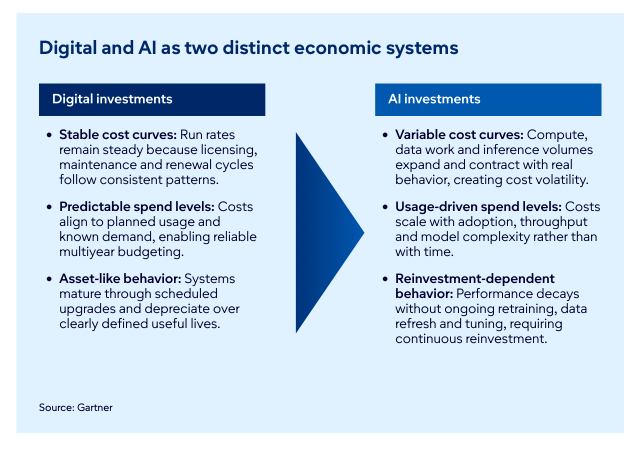
AI cost is consumption-based, invisible, and grows with enthusiasm.
You don’t have a license with a fixed seat count. You have a meter. Every enthusiastic employee, every long context window, and every agent running a few extra loops adds to a bill that arrives thirty days later with no line-item explanation.
Chamath Palihapitiya put a trajectory on it on the All-In podcast in July, citing data from his firm, 8090 Industries: enterprise token spend is doubling roughly every 45 days, while measured productivity sits around 5%.
His warning was aimed directly at your seat.
Most CEOs and CFOs have no idea how much of this is happening inside their organizations, and it eventually surfaces as an earnings miss that somebody blames on finance.
3. Your auditor is running the experiment on themselves first
While CFOs debate pilots, the Big Four moved into production and started restructuring their own firms around it.
PwC launched an AI-native Office of the CFO business on 14 May, built on Claude, after running it internally first on journal entries, variance analysis, and annual planning. They’re training and certifying 30,000 US professionals to deliver it and report client delivery improvements of up to 70%, including insurance underwriting compressed from ten weeks to ten days.
EY and Microsoft committed over $1 billion across five years on 21 May, embedding Microsoft engineers alongside EY consultants. EY deployed Copilot to 150,000 people and is scaling past 400,000, with an initial focus that includes finance, tax, and risk.
KPMG built Workbench, a multi-agent platform on Azure. Deloitte built Zora AI with Nvidia, automating invoice processing and financial trend analysis.
Those are the announcements. Here’s the part that matters more.
A Financial Times analysis of more than 50,000 Big Four job postings found AI-related roles now make up around 7% of listings. Audit roles are under 3%.
And PwC is cutting graduate hiring.
UK intake dropped from 1,500 to 1,300. An internal US presentation cited AI among the reasons for a planned reduction of roughly one-third over three years.
The honest counterpoint, because it matters: PwC’s global chair has publicly said AI was not behind recent job cuts and pointed at the economy. Both may be partly true. But the hiring mix doesn’t lie. They’re buying AI engineers faster than auditors.
So when your auditors run AI agents against your financial data, the structure of that data, your controls documentation, and your close package stop being internal matters. Their capability becomes your requirement.
The Bottom Line
Everyone is deploying “AI.”
Almost nobody can prove value. The spend is running faster than anyone is measuring it. And the firms that audit you are rebuilding themselves around this issue while their clients are still running pilots.
The thread connecting all three is that this has become a CFO problem specifically.
Not a CIO problem. And not an innovation-team problem.
Because the questions now being asked are
What did we spend, what did we get, and can you prove it?
Those have always been your questions.
The only difference is that nobody set up the books for them this time.
Deloitte’s Q2 survey found only 19% of CFOs say they hold the greatest responsibility for AI governance in their organization. That number is going to move, and it’s going to move whether or not you’re ready.
The first CFO in your peer group who walks into a board meeting with a real AI return, tied to a source, will make everyone else look like they weren’t paying attention.
You have one budget cycle to become that person.
Three things before it closes.
Sort your AI spend into productivity and decision quality, and be honest about the split.
Get a per-team consumption number, then cap it.
Ask your auditor what they’ll expect from your data.
None of it takes a quarter.
All of it takes a decision.
And that’s all for today.
See you on Thursday!
Whenever you’re ready, there are 2 ways I can help you:
If you’re building an AI-powered CFO tech startup, I’d love to hear more and explore if it’s a fit for our investment portfolio.
I’m Wouter Born. A CFOTech investor, advisor, and founder of finstory.ai
Find me on LinkedIn


