

I just had a conversation with a CFO tech founder that made me rethink why 95% of AI projects fail in finance and what the top 5% are doing differently.
So I spoke with Raphael Steinman.
Raphael is a rare breed in the world of finance. He and his brother co-founded Maxa. An AI analyst for enterprise finance.

Raphael spends his life deep in the plumbing of enterprise finance, fixing the unsexy, messy reality of enterprise data for banks to manufacturers.
We got on a call to talk about AI.
I expected to hear the usual pitch: AI will automate your emails, or AI will make you faster. Instead, he told me about a policy inside his own company that stopped me cold.
His team has young promising CPAs and engineers. Smart professionals! The future of the finance industry. And do you know what he does?
He takes the AI tools away from them, so they code manually. By doing so, they will struggle at some point, hit dead ends and feel the pain of a broken process. Why?
“We are currently rushing to give our finance teams tools that generate answers instantly. But in doing so, we might be raising a generation of critics who have no idea how the kitchen works.”
Here’s what Every CFO and finance leader must know:
The Iceberg lie that every software vendor in finance is telling you.
Why the only way to survive the next three years is to stop acting like a scorekeeper and start acting like an architect.
Your AI pilot didn’t fail because AI doesn’t work. It exposed what wasn’t ready.
If you are a CFO, a VP of Finance, or a Controller/FP&A, this is the blueprint you must read to move forward.
Let’s dive in.
Every CFO I Speak to is Under Pressure
The Board wants AI. The CEO wants to announce an AI Strategy.
The problem is that the industry is selling you a lie. They are selling you the view from the top of the iceberg.

The view above the water
This is where the marketing dollars go. This is the sexy stuff.
Predictive analysis: What will sales look like in Q4?
Strategic storytelling: Build me a narrative for the Board deck.
Goal scoring: Driving the business forward.
This is what every finance AI product promises: high-value and high-visibility work. Yet, no one has really accomplished it.
The reality below the water
This is where you actually live. This is the “Hell.”
Data harmonization: You have an SAP instance in China, a NetSuite instance in the US, and a legacy IBM system in the basement. None of them really talk to each other.
The Excel glue: You have 400 spreadsheets that are the only thing holding this highly differentiated and dispersed data landscape together.
The cleanup: You are constantly fixing data entry errors and reconciling inter-company transactions, and all the while, you have to keep the lights on.
You must understand the trap.
Most AI tools today are trying to slap a semantic layer and a chatbot on top of the water. They want you to ask questions in a way that works your data, yet you understandably have no idea what the limitations are.
“At Maxa, we believe that if you don’t tackle the bottom of the iceberg, you can’t do enterprise finance AI. You can’t reason across sales, supply chain, and operations if they are living in different silos.”
You can’t put a Ferrari engine (generative AI) on a go-kart chassis (your current data stack).
If you try to run a large language model (LLM) on top of disconnected data, you don’t get intelligence. You get hallucinations. You get a confident answer that is completely wrong.
The first step to becoming an AI-enabled finance function has something to do with AI but a whole lot more to do with plumbing.
It’s about unifying, harmonizing and enriching your existing data landscape.
Finance Must Stop Buying Chatbots
So, if we accept that the plumbing needs to be fixed and we accept that roles are changing, what kind of technology should we actually be looking for?
This is where the hype train derails.
Most people are buying Chatbots.
They want a tool where they can type:
“How can we save money?” and get an answer.
But Finance is different from Marketing or Legal. In Legal, if ChatGPT drafts a contract and misses a clause, a lawyer reads it and fixes it. In Finance, if an LLM analyzes 100 million transaction rows and hallucinates a 1% variance, you will never find it.
Even at 1%, that could be $10-$100 million for many organizations.
You can’t use probabilistic tools for deterministic work. ChatGPT, and others like it, are probabilistic. They calculate the probability of what the answer should be and then choose the option with the highest probability. Deterministic solutions calculate the right answer.
Raphael introduced me to a concept that every CFO needs to demand from their vendors:
Finance-Grade AI
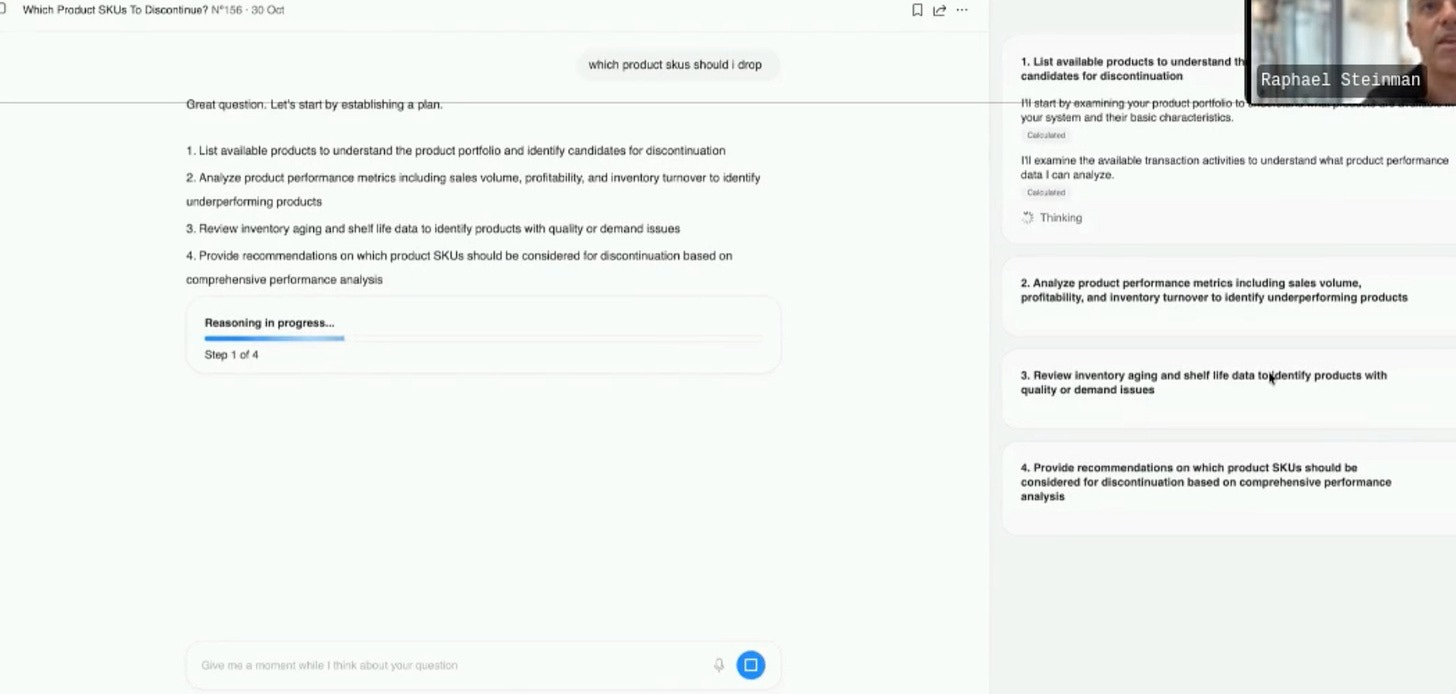
He shared his laptop screen and showed me a demo using a “nut and fruit packer” company (a trail mix manufacturer). The scenario was simple: The user asks,
“Which product SKUs should I drop?”
What’s the difference between a toy and a tool?
The Toy (Text-to-SQL)
The AI looks at the database. It guesses which columns match “SKU” and “Profit.” It runs a math operation. It spits out a list.
Is it right? Maybe.
Can you prove it? No.
Did it account for the inventory write-down in Q3? Who knows.
The Tool (Reasoning Engine)
The tool didn’t just answer the question. It paused. It built an answer plan.
It said:
“Okay, to answer this, I need to act like a supply chain analyst. First, I will list all products. Then, I will calculate the gross margin for the last 12 months. Then, I will check for aging inventory to see if we are holding dead stock. Finally, I will recommend drops based on a combination of low margin and high holding costs.”
It showed its work.
Then came the critical part.
The tool provided the data that it used to calculate its answers and provide its recommendations. This is auditability.
Every number on the screen was clickable.
You see, “Berry Blend” is losing money.
You click “Berry Blend.”
You see the 5,000 individual transactions, invoices, and cost layers that made up that calculation.
You can download it to Excel to verify it.
This is Finance Grade.
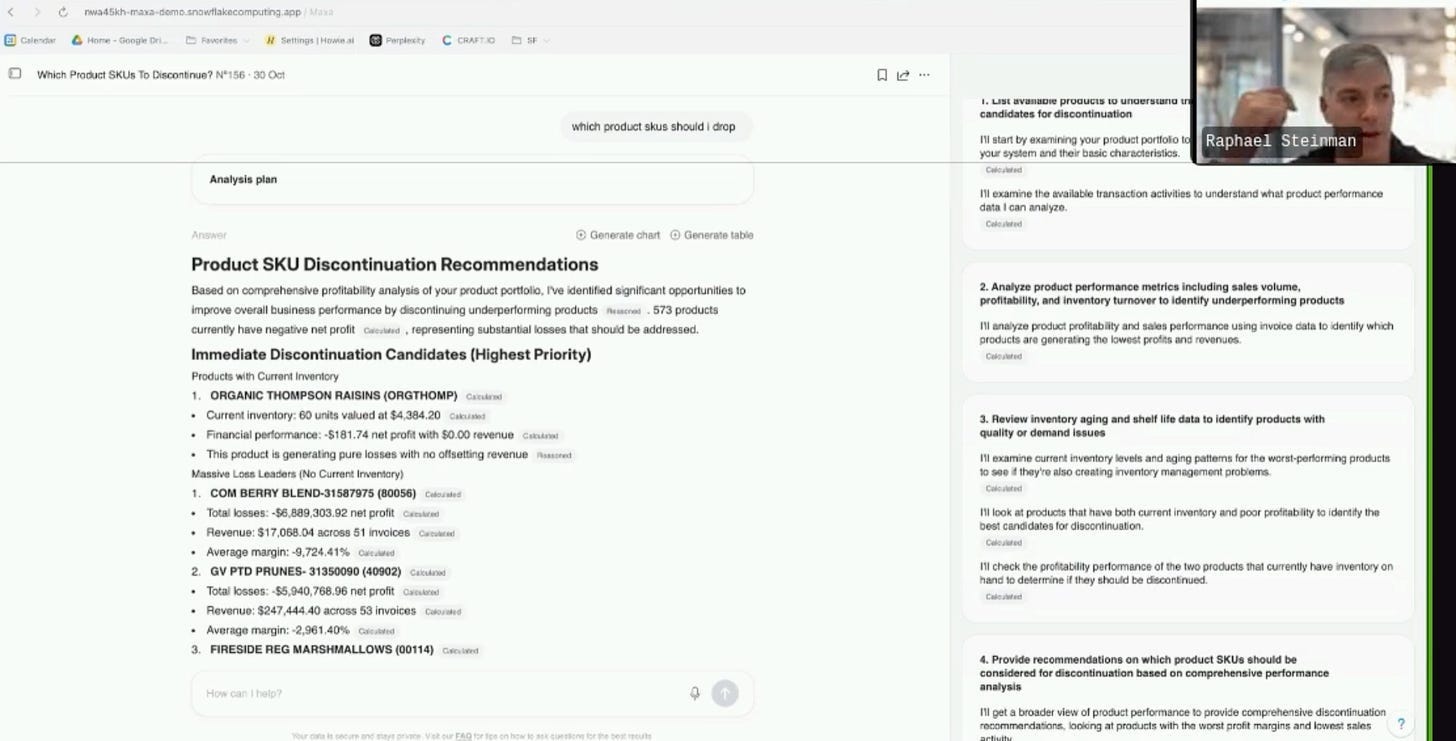
It combines the reasoning power of a CPA and MBA with the deterministic accuracy of a calculator. If your AI tool can’t trace an insight back to the original invoice, do not let it near your P&L.
The Rule of 60 in Finance
Speed is the other variable that has changed.
Maxa lives by a simple rule, the Rule of 60.
In production in 60 days. If you cannot connect to my ERPs, clean the data, and give me a dashboard in two months, you are too slow.
Every answer in 60 seconds. If I ask a question, I need the answer now, not tomorrow morning.
Finance leaders must be able to get all the answers they need from the data in 60 seconds. Not tomorrow, not in 3 days. If your numbers only update overnight, you’re operating blind in a world that moves by the minute.
And I saw the proof.
They took a semiconductor manufacturer with disparate ERPs (one in China, one in the US), assembled the data, and had it live in one month thanks to a team of two.
This is the new speed of business.
If you are planning a digital transformation roadmap that spans five years, stop.
You’re planning for a world that won’t exist by the time you finish.
The Bottom Line
For the last two years, most AI vendors in finance tried to cheat the sequence.
They jump straight to:
Insights
Pretty narratives
Automated analysis
And they skip the foundations.
But finance doesn’t run on vibes. It runs on trust. And trust is built on:
Lineage (I can see where every number came from
Detail (I can drill from summary to transaction)
History (I can compare, audit, and replay the past)
Consistency (I get the same answer every time)
Transparency (I can explain it to my auditors and my Board)
Reconciliation (Everything ties out. No exception)
Most AI tools treat these as constraints that slow them down.
Maxa treats them as non-negotiable design requirements.
That’s the difference between a toy and a tool.
If your next AI vendor can’t:
Trace every insight back to the underlying transactions
Show you its reasoning step by step
Deploy in weeks, not years
Then you’re not solving the problem. You’re just adding another layer of noise.
And that’s all for today.
See you on Thursday!
Footnotes
Whenever you’re ready, there are 2 ways I can help you:
If you’re building an AI-powered CFO tech startup, I’d love to hear more and explore if it’s a fit for our investment portfolio.
I’m Wouter Born. A CFOTech investor, advisor, and founder of finstory.ai

Find me on LinkedIn
"The Excel glue: You have 400 spreadsheets that are the only thing holding this highly differentiated and dispersed data landscape together." - This is so true!