

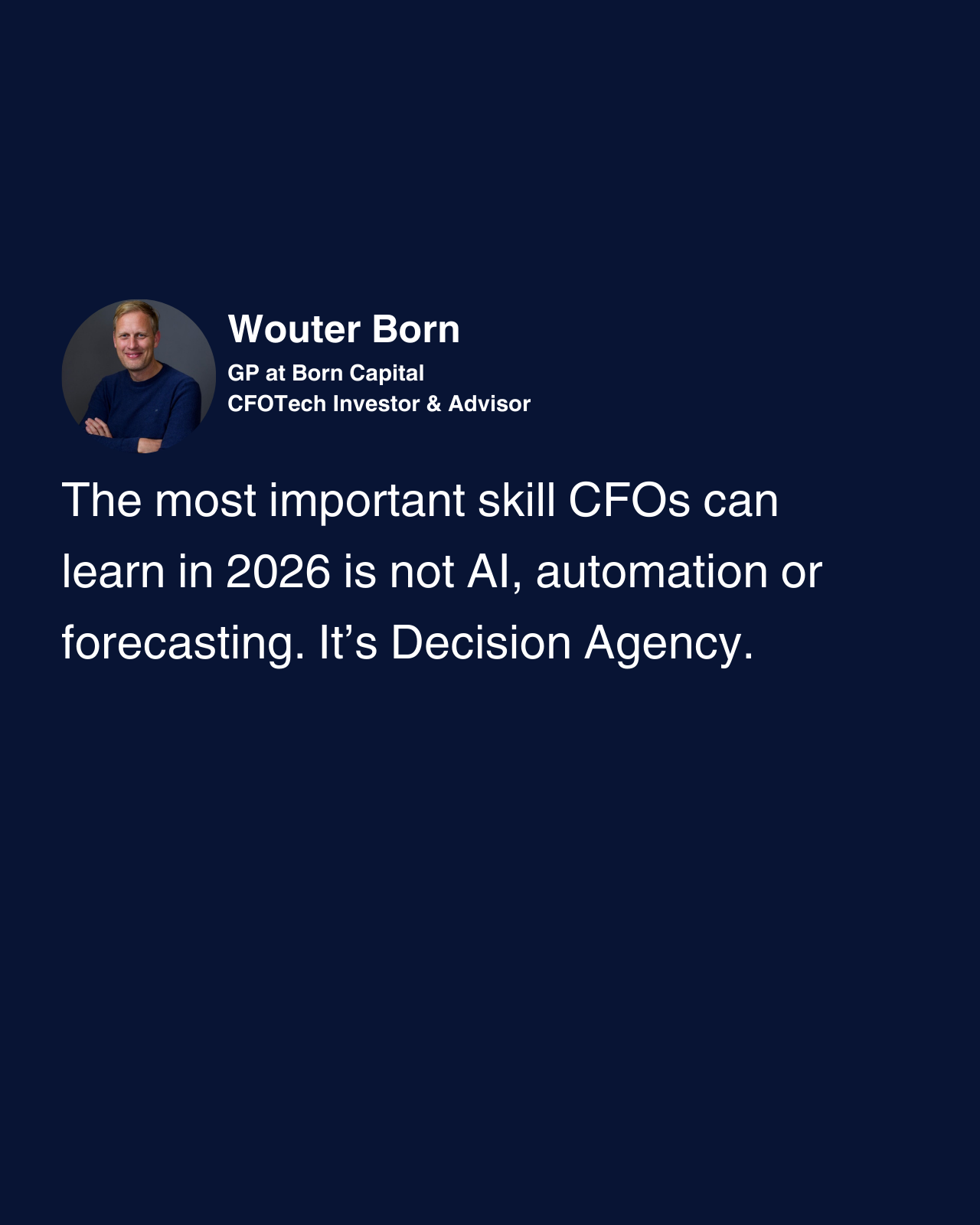
Most finance AI projects don’t fail because the model is weak.
They fail because the finance operating system is undefined.
If you let AI touch this process tomorrow, where does authority live, where does accountability live, and where does auditability live?
That’s the whole game in 2026.
You must decide faster than others.
Most modern CFOs now spend the majority of their time on transformation rather than reporting, with AI, forecasting, and growth modeling sitting at the center of their agendas.
Finance is being rebuilt into something closer to an operating system for the enterprise, rather than a department that just explains outcomes after the fact.
The CFO role is expanding because someone must own decision agency and finance is the last function structurally positioned to do it.
Read on.
The Lie CFOs are Being Sold
The industry is selling you the top of the iceberg.
“Ask your ERP anything.”
“Auto-generate board narratives.”
“Predict your quarter in seconds.”
“Get instant insights.”
It all sounds like the CFO dream: speed, clarity, and control.
But here’s the reality.
The top of the iceberg is output.
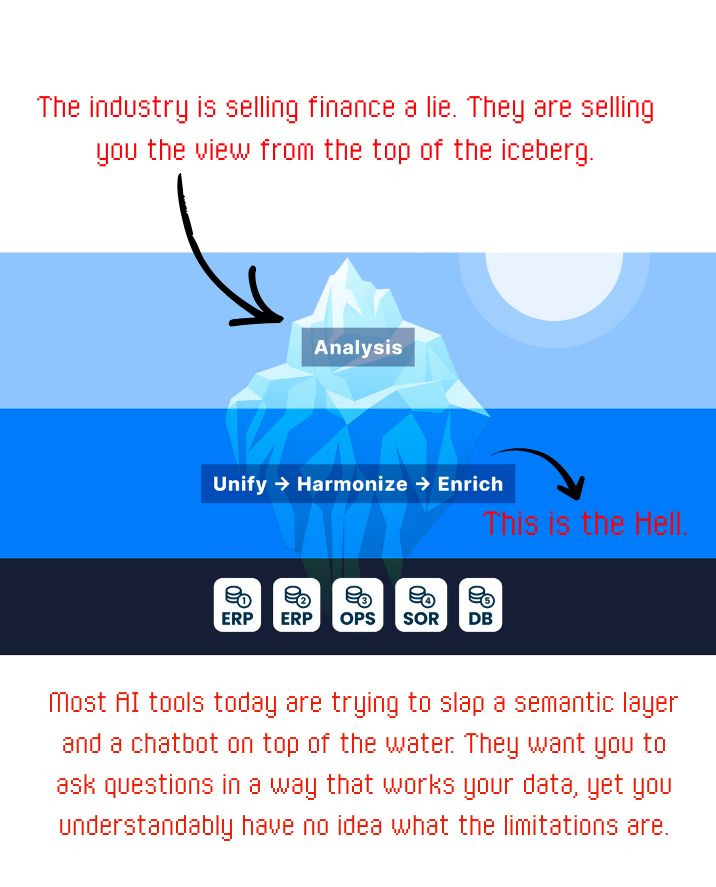
And finance doesn’t collapse because output is slow.
Finance collapses because the system underneath the output is fragile.
Above the water: Output
Decks
Forecasts
Insights
Narratives
Dashboards
Below the water: The operating system
Who can approve what, and why
How exceptions escalate
How decisions get logged
How policies get enforced
How data becomes “true”
How cash gets seen early
How spend gets governed without becoming bureaucratic
How you prove it when someone says: “show me the backup”
Most AI finance is trying to improve the top.
High-agency CFOs rebuild the bottom.
Modern CFOs Need Decision Agency
It isn’t about authority or title.
It is about who frames the problem, defines the trade-offs, and accepts responsibility for the consequences.
In many companies, finance has deep visibility but shallow agency. The team can explain what happened, reconcile variances, and quantify risk, yet stops short of explicitly stating what should happen next.
AI makes this gap impossible to hide.
When execution becomes cheap, instantaneous, and automated, the only remaining human advantage is judgment under uncertainty… The CFO who can’t translate information into choices becomes an observer of strategy rather than its architect.
High-agency CFOs understand this intuitively.
They don’t treat finance as a reporting layer. But as the decision fabric that runs underneath the business, continuously sensing, evaluating, and adjusting as conditions change.
The Real Definition of a Finance Operating System
When people say finance OS they usually mean a tech stack.
That’s not it.
A finance OS is a set of rules that lets the company move fast without losing control.
It answers five questions cleanly:
Authority: who is allowed to do what? under what thresholds?
Visibility: how quickly do we see cash, spend, risk, exposure?
Delegation: what can be delegated safely, and when does it escalate?
Proof: can we trace every number and decision back to source?
Recovery: what happens when assumptions break or confidence drops?
If those are vague, AI becomes dangerous.
Because AI is not a magic wand.
AI is a force multiplier.
And multipliers multiply your weaknesses first.
The CFO skill that actually matters.
Everyone keeps saying data fluency.
Sure. Necessary.
But data fluency is becoming table stakes because dashboards are cheap now.
The differentiator is something else:
Interpretation under pressure.
The ability to decide:
What matters now.
What doesn’t matter yet.
What looks big but is just noise.
Which metric is lying because it’s lagging.
What looks small but is actually compounding.
This is why elite CFOs don’t become dashboard addicts.
They become signal designers.
They decide what the company sees, when it sees it, and what it must do about it.
That’s not analytics.
That’s governance.
The Bottom Line
None of this works without people who can think beyond the ledger.
High-agency CFOs invest aggressively in skills:
Data literacy.
AI fluency.
Modeling.
Systems thinking
Decision Making.
Learning is embedded into the function, not treated as a side initiative.
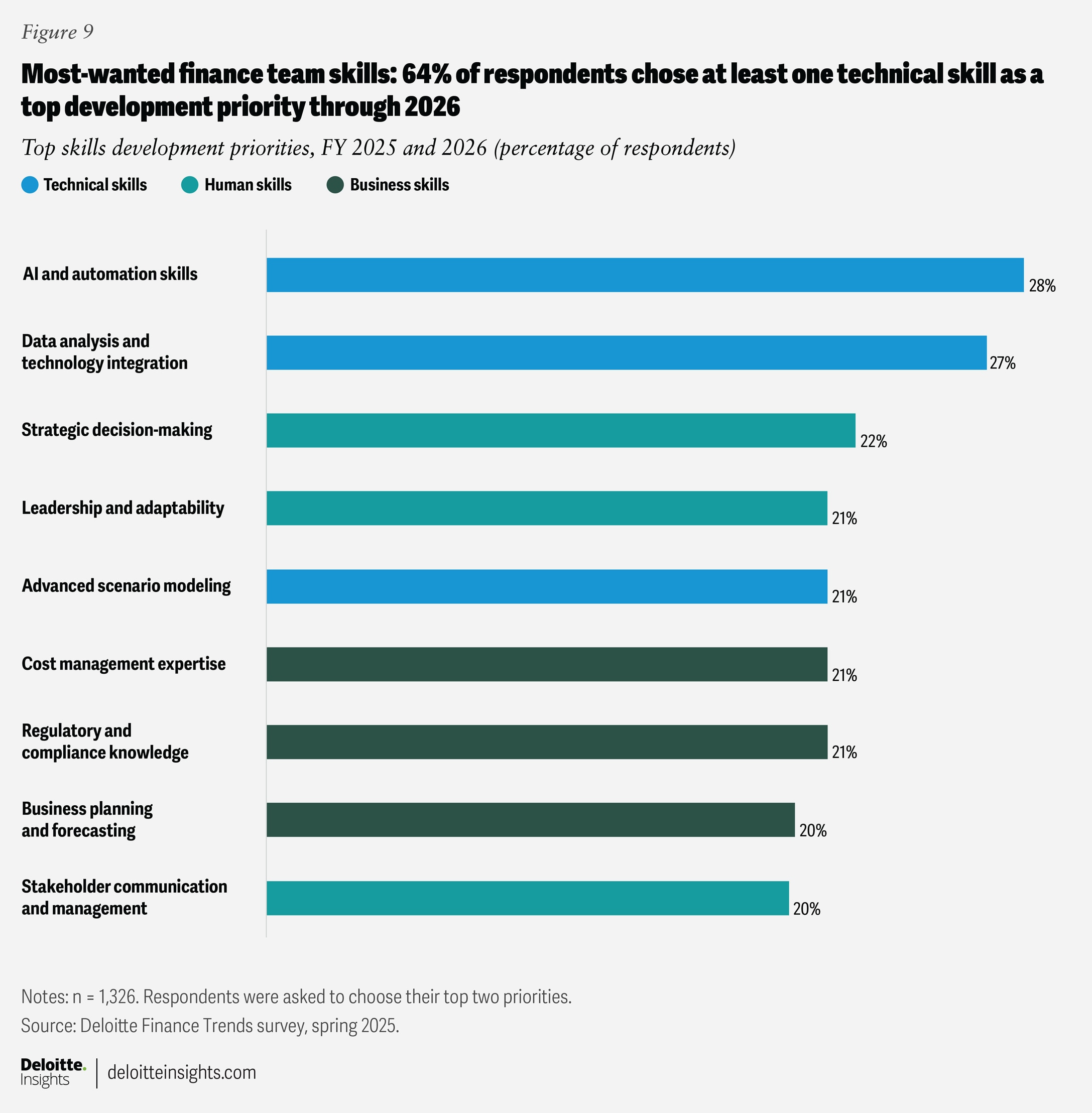
Routine work is offloaded to automation so finance can focus on interpretation, collaboration, and judgment. Experimentation is encouraged through pilots, internal innovation teams, and visible wins that build momentum.
The next generation of finance talent does not want to be data janitors.
They want to build and improve the system.
The CFO who enables that earns loyalty and results.
The CFO role in 2026 won’t be more strategic in a vague way.
It will be strategic in a very specific way:
You will be judged by how your company makes decisions under pressure.
AI won’t save you.
Automation won’t save you.
A new ERP won’t save you.
What will save you is building a finance operating system where:
Delegation is safe.
Authority is explicit.
Cash is visible early.
Controls are embedded.
Every output is provable.
Forecasting is agile, not ceremonial.
Narratives are sequenced for decisions.
Spend is governed without bureaucracy.
If your AI strategy doesn’t include those design requirements, it’s not a strategy.
It’s a failed demo.
And that’s all for today.
See you in 2026 with in-depth research and executive insights.
Whenever you’re ready, there are 2 ways I can help you:
If you’re building an AI-powered CFO tech startup, I’d love to hear more and explore if it’s a fit for our investment portfolio.
I’m Wouter Born. A CFOTech investor, advisor, and founder of finstory.ai

Find me on LinkedIn