

A year ago, asking AI to build a real financial model felt like asking an intern to run the board meeting. It could write a nice summary. It could not build a plan that held together.
That has changed fast.
Google launched Gemini 4 Argon for business on October 13.
If your company runs on Google Workspace, you probably already pay for it, and someone on your team will soon ask whether it can build the budget.
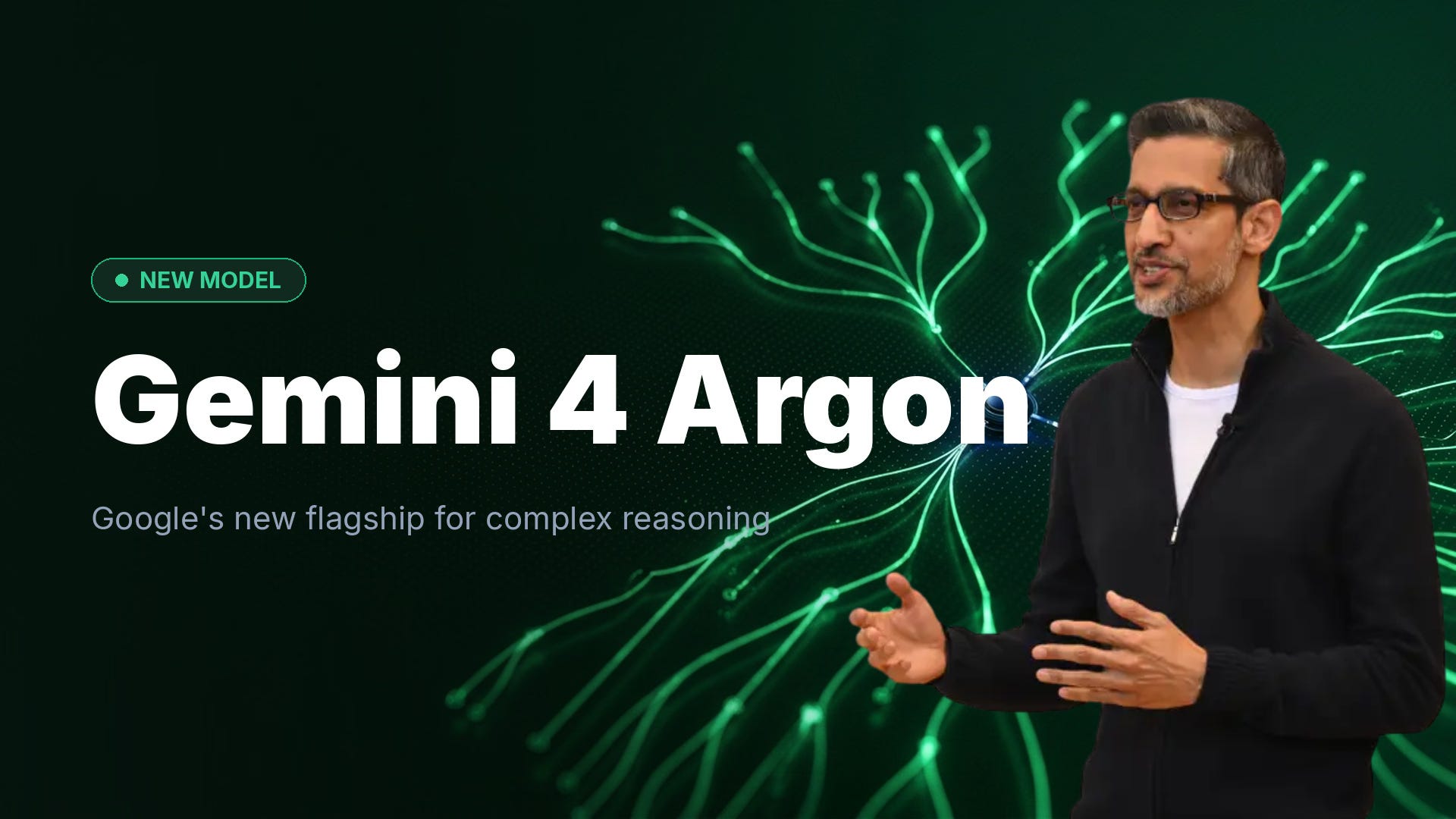
Google says it outperforms other frontier models across domains and ranks #1 on the Vals Index, a benchmark that scores AI on real work in finance, tax, legal, and coding.
It also promises it communicates clearly, keeping you in the loop.
Google pitches Argon for work where mistakes are expensive.
Supply chain planning with many moving parts is on that list, and so is financial modeling where every assumption has to be checked.
Early partners are said to have made better decisions using it in strategic planning, work that used to need hours of expert review.
On paper, that makes it the smartest finance model you can buy.
That’s a big promise.
So I did what any CFO would do with a big promise.
I tested it. I gave it a real finance job and put it next to the other two frontier models, Claude Opus 5.5 and ChatGPT on GPT-6.
Let’s dive in.
The test
I didn’t want a toy example.
I wanted the kind of model that keeps an FP&A team busy for weeks.
So I invented a company called Velo Works, an e-bike maker with 48 models, hundreds of parts, and eight production lines. I asked three AIs, Gemini 4 Argon, Claude, and ChatGPT, to build its full three-year plan in Excel.
That meant starting with how many bikes it would sell, working out the parts and factory time it would need, and ending with the P&L, cash, and balance sheet.
Then I did what real life does.
I hit the plan with shocks: a sudden jump in demand, a supplier raising prices, and the paint shop going down for three months.
Finally, I asked a question with no formula behind it:
What happens if the company stops selling Kids bikes?
I made the company up … I know every right answer in advance. So I can check every single number, not just eyeball, whether it looked sensible.
Claude: the analyst you’d hire
Claude built the whole plan in under an hour, and every number was right.
Then I changed some of the inputs, just like you would in a real budget review, and the whole model updated correctly.
That’s the test that separates a real model from a pretty one.
What impresses me most is how it works.
It showed every step as it went, so I could watch the model being built. It caught a gap in my instructions that I hadn’t noticed. It checked its own work before handing it over. And when an answer depended on an assumption, it told me so instead of hiding it.
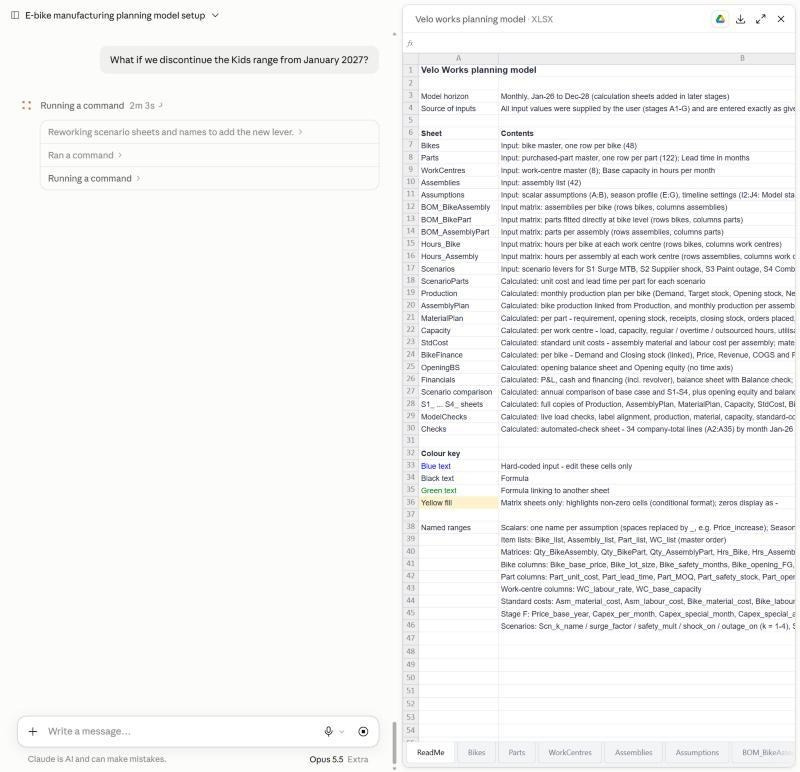
Claude shows every step as it works.
That’s how a good senior analyst behaves.
ChatGPT: brilliant in the chat but broken in Excel
ChatGPT came next. Every number it gave me in the chat was right, and it even caught and fixed one of its mistakes mid-answer.
Then I opened its file in Excel, and a big chunk of the P&L showed errors.
The thinking behind the model was right, but the file it handed over didn’t work in real Excel. It’s like an analyst who explains the model perfectly in a meeting and then sends you a broken spreadsheet.
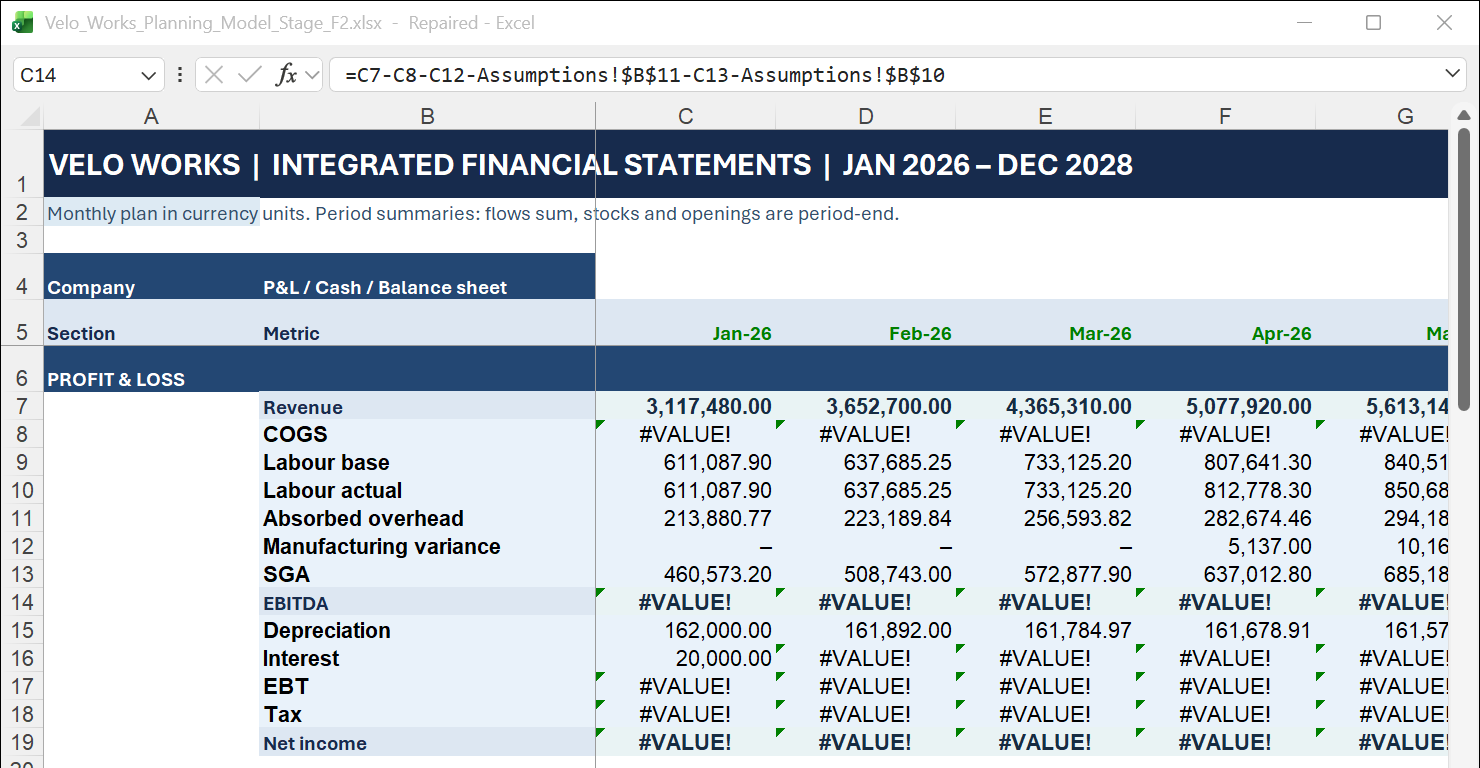
ChatGPT’s file in Excel: broken P&L.
It also struggled with the size of the model.
At one point it couldn’t even open a preview of its own work.
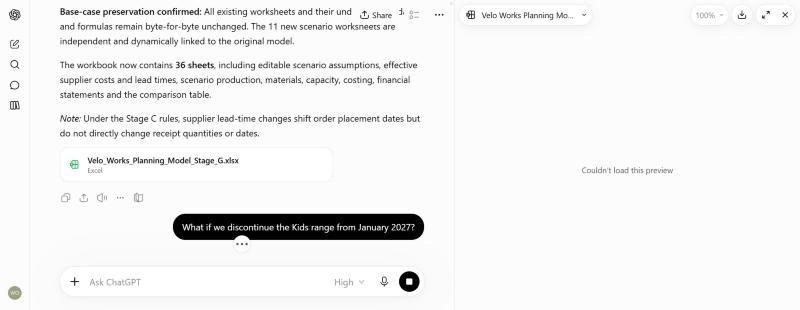
ChatGPT couldn’t even preview its own file.
Gemini Argon: the favorite
Which brings me to Gemini, the model I’m most excited about.

Read on to get the verdict.