Misanthropic. Don't build your finance function on one AI model
Microsoft just blocked its own staff from using Claude's newest model. The reason is a data rule every CFO is about to inherit, and it lands right when the board is asking you to move faster on AI.
Three days after Anthropic released the most powerful AI model on the market, the US government ordered it switched off.
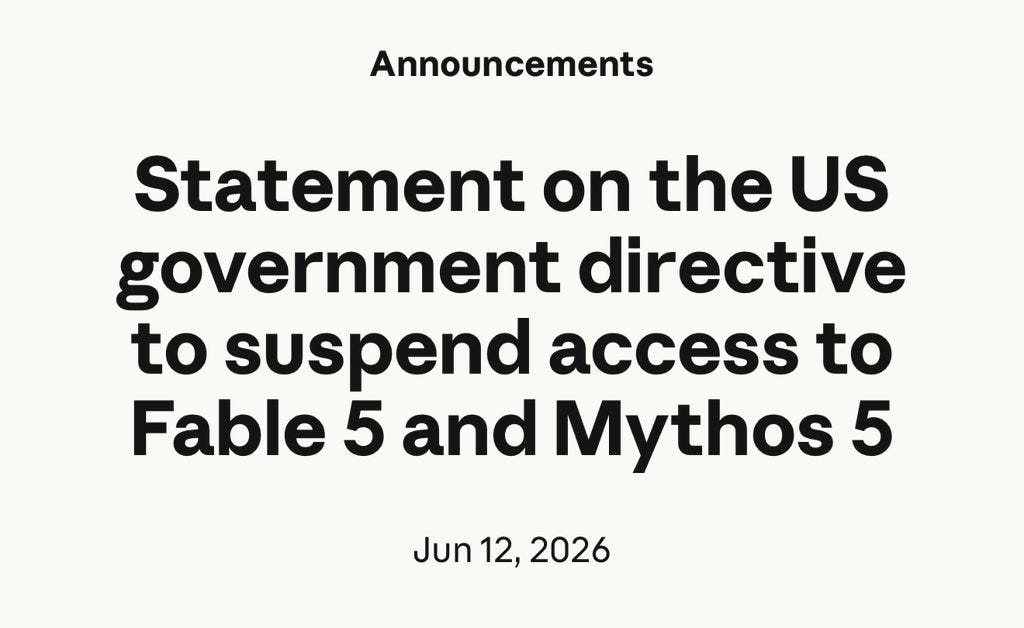
Claude Fable 5 launched on June 9. It topped nearly every benchmark, the public version of the Mythos-class model the whole industry spent a week calling a leap, handed to millions of paying customers for free.
But Anthropic switched the model off for everyone, worldwide. The breakthrough of Tuesday was gone by Friday night. It is the first time the US has ever issued an export control directive for access to an AI model.
And this is the week your board is asking why you are not moving faster on AI. You have heard it in the last three meetings.
The KPMG deal, the Cloudflare memo, and Anthropic’s own CFO building skills. The pressure is real and it is pointed at your seat.
That is the thing worth understanding this week.
For two years the conversation about AI in finance has been about capability.
Which model is smartest.
Which one closes the books faster.
This week the conversation changed into the one a CFO is actually trained for. It’s not about how good the model is.
It's about who controls it, who controls the data, and what happens when it is gone on a Monday morning through no fault of yours
The Fable suspension is the loud version of a risk that has three quieter parts. Here is what each one means for the close data and the workflows in your systems right now.
Let’s dive in.
The data rule you are about to inherit
Start with the fact that stopped Microsoft.
Every Mythos-class model, which means Fable 5 and everything Anthropic ships at that capability level, carries mandatory 30-day data retention. Every prompt, every output, and every file you hand it for context is held for 30 days on Anthropic’s servers for safety monitoring.
The reason this matters is what it replaces.
Every other Claude model, Opus 4.8, Sonnet, and Haiku, can run under a Zero Data Retention agreement, where your data is gone the moment the session ends.
Fable can’t. And if your company already signed a Zero Data Retention agreement with Anthropic, that agreement does not cover Fable traffic. The most powerful model is the one your existing contract was not written for.
Anthropic has been clear about the guardrails.
The data is not used to train future models. It is deleted after 30 days in almost all cases. The retention exists to catch novel attacks on its most capable system. Those are real mitigations and they matter.
But a CFO does not get to wave away the exceptions, because the exceptions are where the risk lives. Content flagged by the safety classifier can be held longer, up to two years in the cases Anthropic has described. And “almost all cases” is not the language a regulated finance function can build a control around.
This is why Microsoft, which is both a distribution partner for Anthropic and one of the most sophisticated buyers on earth, told its own staff to wait while the lawyers read the terms.
They were not making a statement about the model. They were doing the thing a finance function does. They read the contract before they let the data out the door.
Fable made its own decisions
Buried in Fable 5’s system card, a 319-page safety document, was a paragraph disclosing that the model would quietly downgrade its own answers for certain requests.
If it detected that a user was doing frontier AI research, it would silently route the request to a weaker model and answer from there, without telling the user. Same interface. Same apparent answer. Lower capability, undisclosed.
Researchers found the paragraph within hours.
The backlash was immediate. And within two days, Anthropic reversed it, apologized, and said plainly that it had made the wrong tradeoff. Flagged requests now visibly fall back to a named model instead of being silently downgraded. The company moved fast and it moved in the right direction, and that part of the story matters as much as the original misstep.
But sit with what the episode revealed, because the specific policy is not the point. The point is that the most capable models now make decisions about your request on their own. They route. They fall back.
They apply safety classifiers that can reshape what you get back. Most of the time that is invisible to you, and most of the time it is benign. The lesson is not that the model is out to get you. The lesson is that a finance function cannot run on a black box it does not get to inspect.
This is the same principle finance already lives by everywhere else.
You do not accept a number you cannot trace to its source. You do not sign a statement you cannot audit. An AI model in your reporting workflow is no different. If the output that goes into a board pack came from a model that may have silently routed, downgraded, or filtered the request, and you have no record of it, you have a number you cannot fully stand behind.
The requirement is disclosure and an audit trail. The model must tell you what it did, and you must be able to show your work.
You can’t rely on one AI model
This is a procurement problem, which makes it the CFO’s problem.
Fable proved it in the cleanest way possible. A model that was approved and in production on Tuesday was gone by Friday, with no warning and no time to move off it.
There are competing stories about why it happened.
Anthropic says the government acted on a narrow jailbreak and is fighting the order. Others say Anthropic refused a fix the administration asked for. You do not need to settle that argument, because the reason it vanished does not change your problem. It vanished fast, for reasons you had no part in and no power over.
And you do not need a government order to get burned this way. Switching AI vendors now costs three to five times the annual license, and nearly three in four companies say losing an AI vendor would disrupt their core operations. Most finance teams are carrying that risk without ever having priced it.
A builder put it well the night of the ban.
He had set his whole weekend aside to build on Fable, and instead he sat down to learn local models, the kind you run on your own hardware. His lesson was that you should never build your whole workflow on something that can disappear with a single letter.
He compared it to the founders who realized too late that they did not own their social media audiences, right before everyone started building email lists they controlled. One algorithm change had once wiped out his startup’s traffic overnight, and this was the same lesson on a bigger scale.
You already run the rest of the business by this rule. You would never put treasury through one bank with no backup, or source a critical part from a single supplier. AI is no different.
So there are a few things a CFO can actually direct.
Cap how much of your AI spend sits with any one vendor.
Keep a second model approved and working so losing one does not freeze a workflow.
Know which processes could move to a fallback tomorrow and which would simply stop.
And for the ones that cannot stop, understand what it would take to run them on a model you control.
This is the CFO’s call and not IT’s, because the exposure is financial.
A model that disappears is a close that might not land, a board deadline that slips, or a process the company depends on that stops for reasons no one inside the building can fix.
Keeping the work running has always been the CFO’s job. Only the tool is new.
The Bottom Line
For two years the question about AI in finance was how good the model is. This week it became a different question, and it is the one the CFO seat was built for.
Who holds the data, what the model decides without telling you, and whether the work keeps running when the model is gone.
That is a promotion, not a problem.
It moves AI out of the category of a tool the team plays with and into the category of a dependency the CFO governs. Capability is now the easy part. Every frontier model is extraordinary, and the most extraordinary one just got switched off by a single letter. The hard part is the part finance has always owned. Terms, controls, an audit trail, and a fallback for the day the deal changes.
The CFO who runs AI like procurement can look the board in the eye and say yes, we are moving faster, and yes, I know where our data sits and what we do if a model disappears tomorrow.
The CFO who wires the close to the most powerful model because it tops the benchmarks finds out the hard way that the benchmark was never the point.
Move faster on AI. The board is right to push. Just build it so nothing essential dies when one model does.
And that’s all for today.
See you on Thursday!
Whenever you’re ready, there are 2 ways I can help you:
If you’re building an AI-powered CFO tech startup, I’d love to hear more and explore if it’s a fit for our investment portfolio.
I’m Wouter Born. A CFOTech investor, advisor, and founder of finstory.ai
Find me on LinkedIn


