

Two data points landed on my desk this week.
They shouldn’t make sense together. But they do.
CFO turnover just hit a 7-year high.
CFO-to-CEO promotions hit a 10 year high.
One group of CFOs is burning out and walking away.
Another group is getting tapped to run the entire company.
Same title but opposite trajectories.
This isn’t a crisis. It’s a divergence. And AI is the wedge making the gap wider every quarter.
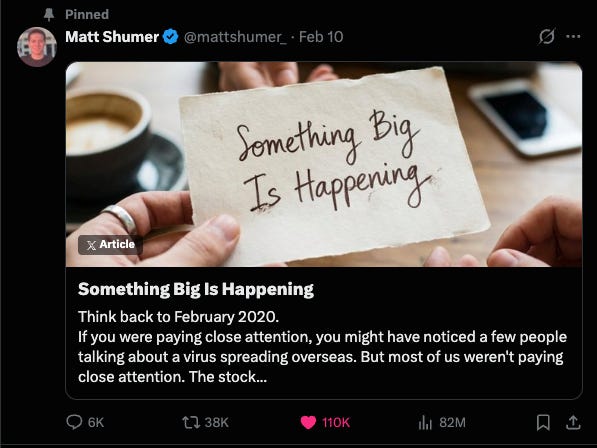
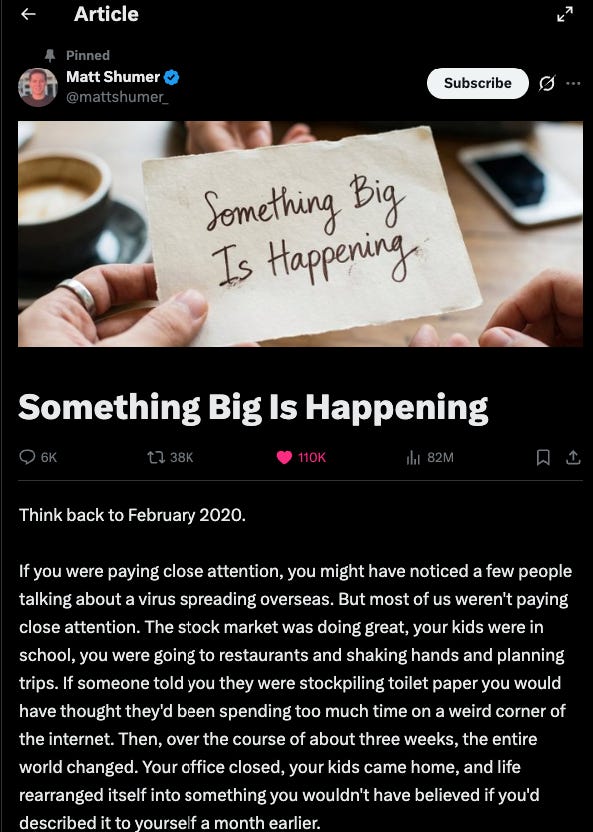
Meanwhile, a viral post from an AI CEO called “Something Big Is Happening” racked up over 82 million views this week. His claim?
“I am no longer needed for the actual technical work of my job.”
If you’re a CFO reading that and thinking that’s not my world yet…you’re right.
But the data says the window is closing fast.
Let’s dive in.
The Great CFO Divergence
Russell Reynolds just released their 2025 Global CFO Turnover Index. The numbers are brutal.
316 new CFO appointments worldwide. A seven-year high. Up 10% year-over-year.
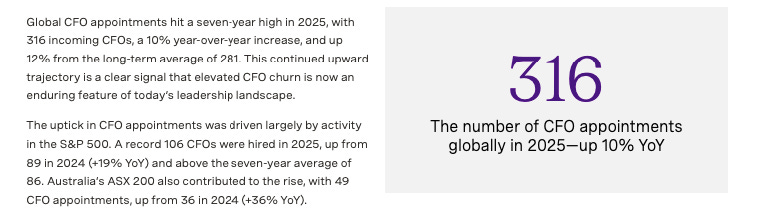
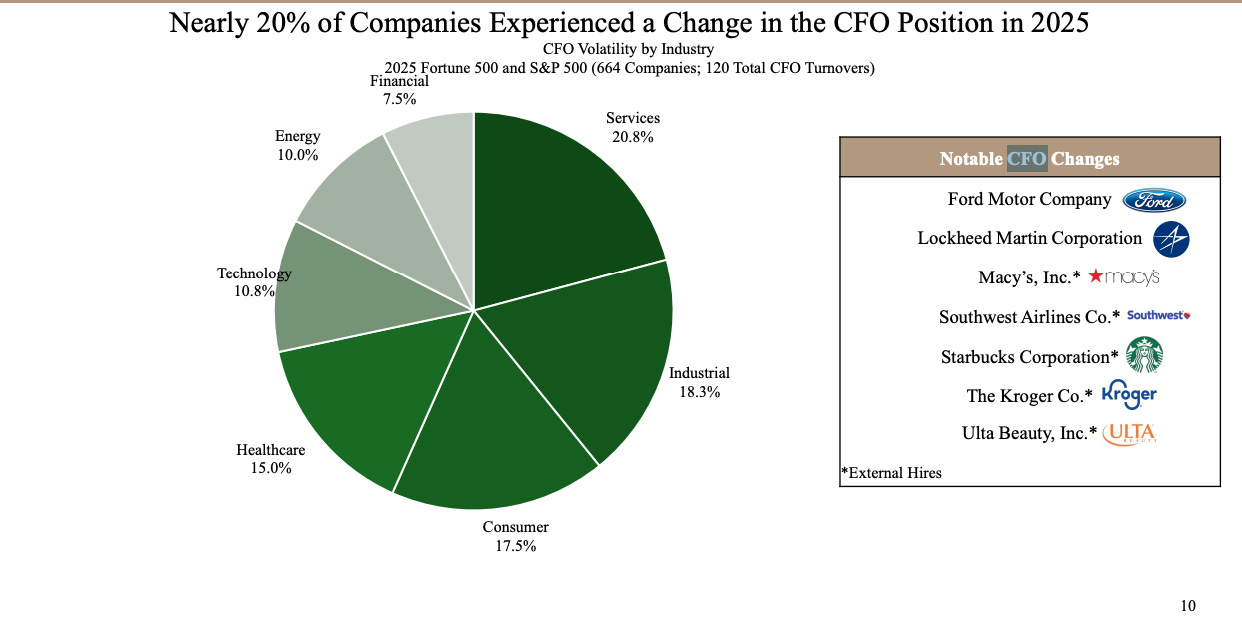
Among S&P 500 companies, CFO churn spiked 19% to 106 hires, blowing past the seven-year average of 86. The CFO seat is now the most volatile chair in the C-suite, with 120 turnovers at Fortune 500 and S&P 500 firms, compared to 78 for CEOs and 61 for COOs.
But here’s the part that stopped me.
60% of departing CFOs in 2025 chose to retire or step back to board-only roles. That’s a seven-year high, up from 55% the year before. The average age of these retirees? 56.6 years. The lowest in six years.
These aren’t people aging out gracefully. They’re tapping out early.
Jim Lawson, who co-leads Russell Reynolds’ financial officers practice, said it directly:
“There are a lot of CFOs that were just exhausted from that continuous cycle of being a public company, working through the quarters, and it really just takes a toll over a period of time.”
The why isn’t mysterious.
The CFO role has metastasized.
Nearly 90% of CFOs now report more involvement in digital transformation and risk management than three years ago.
Two-thirds are shaping ESG and sustainability strategy. They’re expected to govern cybersecurity, manage AI adoption, navigate tariff chaos, run talent strategy… and still close the books on time.
Burnout and work-life balance are the top drivers.
Now flip the coin.
Crist Kolder’s 2025 Volatility Report found that 10.3% of sitting CEOs at Fortune 500 and S&P 500 firms came directly from the CFO chair. The highest rate in a decade.
Up from 7.1% in 2024. Every single one of those promotions was internal.
Russell Reynolds’ own data tells a similar story:
34% of outgoing CFOs who took new roles in 2024 moved into a president or CEO seat. Nearly double the 20% from the prior year.
Fernando Fernandez went from CFO to CEO of Unilever. Chris Turner made the jump at Yum! Brands. Lori Koch took the top job at DuPont.
Kristy Honiotes at Crist Kolder nailed it:
“CFOs with a broader mandate than finance are carving a path to CEO.”
Two populations but the same job title.
One is drowning. The other is ascending.
The question is, what separates them?
Something Big is Happening
Matt Shumer is the CEO of HyperWrite. His post “Something Big Is Happening” went viral this week… over 82 million views.
He described giving AI a task in plain English, walking away for four hours, and coming back to find the work done.
Done well. Better than he would have done it himself.
His timeline of AI capability is worth paying attention to:
2022: AI couldn’t reliably multiply 7 times 8.
2023: It passed the bar exam.
2024: It was writing working software and explaining graduate-level science.
Late 2025: Some of the best engineers in the world said they’d handed over most of their coding work to AI.
The METR research group, which benchmarks AI capability, is tracking something directly relevant for CFOs:
The time horizon of AI agents. How long can they complete tasks autonomously?
This metric is doubling every 7 months. With recent data suggesting it’s accelerating to every four. AI went from completing tasks that take a human expert 10 minutes… to one hour… to several hours… to nearly five hours of expert-level work autonomously as of November.
Shumer explicitly calls out financial analysis.
Building models, analyzing data, writing memos, generating reports… as one of the domains where AI is already functioning at a professional level.
So why do the majority of CFOs still report no impact?
Because the models aren’t the bottleneck. The operating system is.
I covered this exact gap in my last newsletter, the difference between AI that sounds smart and AI that can actually do finance-grade work. Most companies are stuck buying chatbots when they need reasoning engines.
They’re automating fragments instead of redesigning workflows end-to-end.
59% of finance functions are using AI in 2025-2026.
Up from 37% two years ago.
But Bain Capital Ventures surveyed 50 CFOs and found 71% are not actually using generative AI in their core finance and accounting workflows.
Gartner reported 91% of organizations see only low or moderate impact from initial AI deployments.
Almost everyone says AI matters. Almost no one has figured out how to make it work at scale.
That gap is exactly where the CFO divergence lives.
The CFOs who are getting it right aren’t dabbling.
One CFO at Fanatics Betting & Gaming built a custom AI workflow that automated vendor identification and journal entry preparation during month-end close.
The process went from 20 hours to 2 hours per month. AI adoption in accounts payable jumped fourfold in a single year, from 7% to 29%. One CFO reported AI forecasting tools reaching up to 95% accuracy in ARR predictions.
One group uses AI to do the same work faster.
The other uses AI to do different, higher-value work entirely.
That’s the split.
What Happened To CFOs
After digging through the data this week, the pattern is clear. The CFOs making the leap to CEO share 3 characteristics that the burned-out cohort largely doesn’t.
1. They expanded beyond finance before they were asked to
Every notable CFO-to-CEO promotion in 2024–2025 involved a finance chief who had deliberately reached into operations, strategy, or general management. Chris Turner at Yum! Brands took on the chief franchise officer role alongside CFO. Amrita Ahuja at Block absorbed the COO function. Fernando Fernandez at Unilever was commended for his profound knowledge of operations.
The promoted CFOs didn’t wait for the expanded mandate to be thrust upon them. They sought it out.
2. They used AI to create strategic capacity, not just operational efficiency
The distinction matters enormously.
Operational AI saves hours. Strategic AI changes what you spend those hours on.
The CFOs who are winning aren’t just automating AP workflows. They’re using AI-powered scenario modeling to walk into board meetings with three possible futures fully modeled. They’re using predictive analytics to spot revenue risk before it hits the forecast.
An unnamed CFO in Egon Zehnder’s 2025 report captured the mindset shift perfectly. AI will enable CFOs to move from responding to prompts to prompting the human being to capitalize on opportunities and connections they might not have been able to see before.
That’s the difference between surviving the role and transcending it.
3. They treated the role’s expansion as a feature, not a bug
The same forces are burning out one group.
ESG, cybersecurity, digital transformation, and talent strategy are exactly the forces creating the CEO pipeline for the other.
Edmund Reese, CFO of Aon, put it directly:
“The CFO role has moved beyond bookkeeping and accounting. I’ve used the term strategic growth partner. That means you’re not just closing the books. You are engaged in technology. You’re engaged in marketing and understanding what will resonate with clients and drive growth.”
The CFOs who see the expanded mandate as an impossible burden are the ones retiring at 56.
The ones who see it as CEO training are the ones getting promoted.
We’re Hosting A Private Insider Session
If you want to see how AI is actually used when decisions matter, you’ll want to be in the room. This is not a demo. You can ask questions and challenge.
Insider Session with AI CFO (LIVE)

We’re hosting a private Insider session with a former CFO and now VP of Finance who uses AI in his day-to-day finance workflow.
You’ll see how a CFO actually uses AI across:
Excel models.
Forecast updates.
Board and CEO prep.
Margin and cost decisions.
He’ll walk through:
What files he uploads.
What questions does he ask AI?
What outputs he trusts (and what he ignores).
Where AI saves time, and where it doesn’t
This is how AI fits into a real CFO workflow.
Who this is for
CFOs, FP&A and finance leaders.
Anyone responsible for decisions, not just analysis.
What to expect
Live walkthrough.
Open Q&A.
Honest discussion of what breaks.
Access
Insider members only.
Small group to keep it practical.
The event is on Thursday Feb 19 11:30 AM ET
The Bottom Line
The CFO role isn’t getting harder. It’s getting different.
The operational component is being automated away, month by month, whether individual CFOs participate or not. What’s left is the strategic component: capital allocation, narrative control, stakeholder management, technology governance, and organizational design.
The median CFO tenure before becoming CEO is three years and eight months. The average age gap between newly hired CFOs and CEOs dropped to just 1.3 years in 2025… the smallest on record.
The path to CEO has never been shorter.
But the window may be narrowing. AI is compressing the timeline for this divergence. The CFOs who invest the next 12 months in building AI-powered strategic capacity will be positioned on the right side of the split.
The rest will be staring at a role that’s simultaneously too big to manage and too small to matter.
And that’s all for today.
See you on Thursday.
Whenever you’re ready, there are 2 ways I can help you:
If you’re building an AI-powered CFO tech startup, I’d love to hear more and explore if it’s a fit for our investment portfolio.
I’m Wouter Born. A CFOTech investor, advisor, and founder of finstory.ai

Find me on LinkedIn
First time reader! Really great write up.