There are two kinds of finance people
There are two kinds of finance people. One is about to disappear. Deloitte just published its Q2 2026 CFO Signals survey this morning.
Deloitte’s just released its Q2 2026 CFO Signals survey this morning.
When Deloitte asked what CFOs actually use AI for inside the finance function, the top answer, at 51 percent, was operational productivity.
But before diving into that, every CFO must understand there are two kinds of finance people.
The ones who follow and the ones who think.
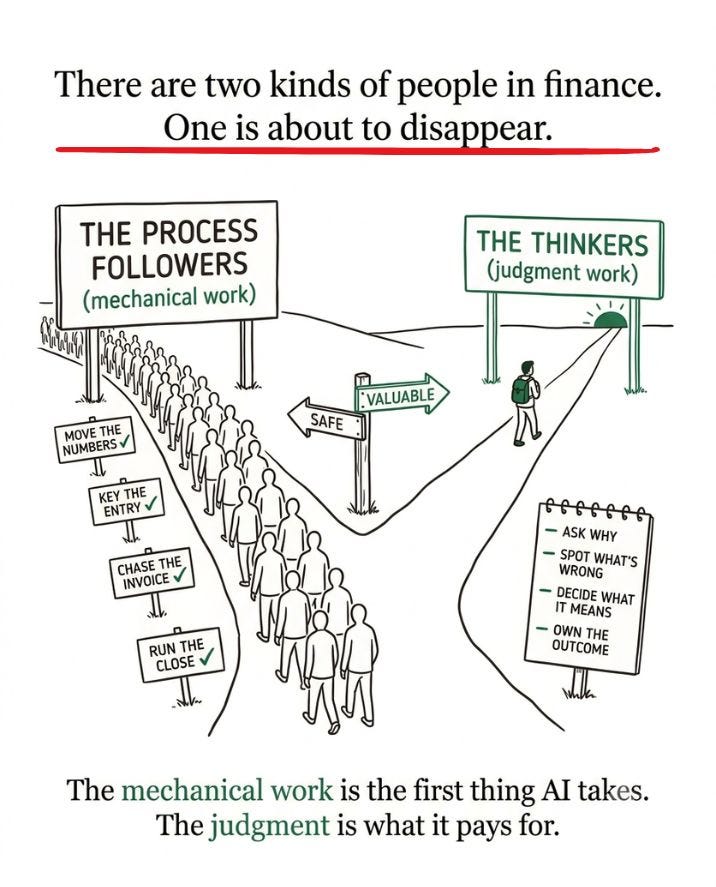
The process-followers
They move a number from one place to another.
The work is necessary today, but it’s entirely mechanical. There’s no judgment in it. You’re a pair of hands moving data across a gap that software is about to close.
Just to be clear, the process itself isn’t bad. It’s that the human simply following the process is the redundant part. The thinker isn’t a maverick; they’re someone who knows when the process is wrong.
Didi looks at that work and can’t find a reason it survives.
I don’t see why we need someone who takes care of payments to vendors. I literally can’t see why we need it.
The thinkers
They look at a number and ask why.
By contrast, thinkers see COGS jump while revenue falls, and they know something’s wrong before anyone tells them. They decide what the number means and what to do about it.
That work doesn’t shrink when AI arrives.
It explodes because, for the first time, one thinker can cover the ground that used to need five process-followers just to assemble the data.
Most finance people think their job security comes from knowing the tools. Knowing the ERP, being fast in Excel, and owning the close process.
That’s backwards.
The better you are at the mechanical work, the more replaceable you become, because that work is the first thing to go.
The people who feel safest are the most exposed.
The US Bureau of Labor Statistics projects that bookkeeping, accounting, and auditing clerks will lose 94,300 jobs between now and 2034, a decline of 6%.
But the interesting thing is over the same period, accountants and auditors grow five percent, and financial analysts grow six percent.
Read on.
What AI is doing to CFOs
When Deloitte asked what CFOs actually use AI for inside the finance function, the top answer, at 51 percent, was operational productivity.
Meeting transcripts. Email drafts. Administrative work.
Financial planning and budgeting came second at 44 percent.
Analyzing financial data came third at 41 percent.
In the office of the CFO, in the middle of 2026, the most common application of the most significant technology of our lifetime is writing emails faster.
That is the split.
Not between finance people and machines. Between two kinds of finance people, both of whom now have AI, using it for entirely different things.
The best study we have on this is not a survey or a prediction.
Researchers from MIT and Stanford analyzed more than 200,000 transaction-level records across 79 accounting firms and surveyed 277 accountants, published in the Journal of Accounting Research. They measured what changed when accountants actually started using AI. MIT Sloan’s summary is here.
The finding is not that people were replaced.
It is that their time moved.
This is what people miss when they argue about whether AI takes finance jobs. It does not take the job. It takes the part of the job that was never the valuable part and hands the time back to whoever knows what to do with it.
If you have judgment, you now have leverage on it.
If you do not, the thing you were doing just got cheaper.
Finance salaries are growing
If the split were theoretical, compensation would not have moved. It has.
Robert Half’s 2026 research, based on more than 400 US finance and accounting leaders, found that 87 percent now pay higher salaries for candidates with specialized skills in the same role. The specific skills they pay for are financial reporting, data analytics, and financial modelling.
Not speed at transaction processing but Interpretation.
Deloitte’s quarterly survey of 200 CFOs at companies above a billion in revenue makes the intent explicit. Half named digital transformation of finance as their top priority for 2026. And the leading talent priority, cited by 49 percent of them, was automating processes to free employees for higher-value work.
There is one more force worth naming, because it explains why the change is happening faster in some places than others. The profession has a pipeline problem.
There are fewer CPA candidates.
Firms are not automating routine work purely to cut cost.
Many are automating because they can’t hire, and every hour of judgment they can free up is an hour they could not buy on the market at any price.
The shortage and the automation are not opposing forces. They are the same story. Mechanical capacity is getting cheap while judgment stays scarce, and the gap between the two is widening.
The Bottom Line
Everyone has the AI now.
What remains is the question of what you point it at.
If you use it to produce the same work faster, you bought efficiency, and efficiency is a fine thing to buy. It is also the thing your competitor bought, from the same vendors, in the same quarter, and it shows up in nobody’s strategy.
If you use it to change what your finance function spends its time deciding, you bought something else entirely, and the data suggests hardly any people have.
The split is never between finance people and machines.
It is between the people who use a general-purpose thinking tool to type faster and the people who use it to think about more things.
And that’s all for today!
See you on Sunday.
Whenever you’re ready, there are 2 ways I can help you:
If you’re building an AI-powered CFO tech startup, I’d love to hear more and explore if it’s a fit for our investment portfolio.
I’m Wouter Born. A CFOTech investor, advisor, and founder of finstory.ai
Find me on LinkedIn


