

On October 8, a16z published a piece with the headline “You Need a New CFO”. Seema Amble, Ivan Makarov, and David Borecky argue AI has rewritten the job.
The scarce skill now, they say, is
“Designing the operating system the company runs on.”
I agree with half of that sentence.
The operating system part is right.
But the “new CFO” part is backwards.
I believe the new CFO is not the answer if you don’t have an operating system.
What you must do instead is keep your CFO.
And build an AI Operating System.
Read on.
Where a16z nails it
a16z describes a finance person “who has become proficient in Codex or Claude Code and leads the charge on building tools for the team.”
Their best example comes from Anthropic.
The finance team there maintains a library of 70+ finance-specific AI skills they treat like production code.
One skill produces a 90-95% complete monthly financial review in about 30 minutes. That is the right mental model: skills you version, test, and reuse, rather than prompts you paste.
Anthropic's CFO uses Claude for the monthly financial review. I built MFR Skill.md every CFO can install

Anthropic just went from $9 billion to over $30 billion in revenue in 4 months.
They’re also right about a trusted chain from every number to its source, about continuous planning, and about who gains most from AI: at Anthropic, the heaviest user on the finance team is the head of tax.
You need a new CFO; it sounds like you need a16z portfolio
The finance leaders in the piece run Anthropic, OpenAI, and a16z, growth-stage companies. The tools named are seven a16z portfolio companies: Rillet, Concourse, Lio, Stuut, Sphere, Petual, and CFO.ai.
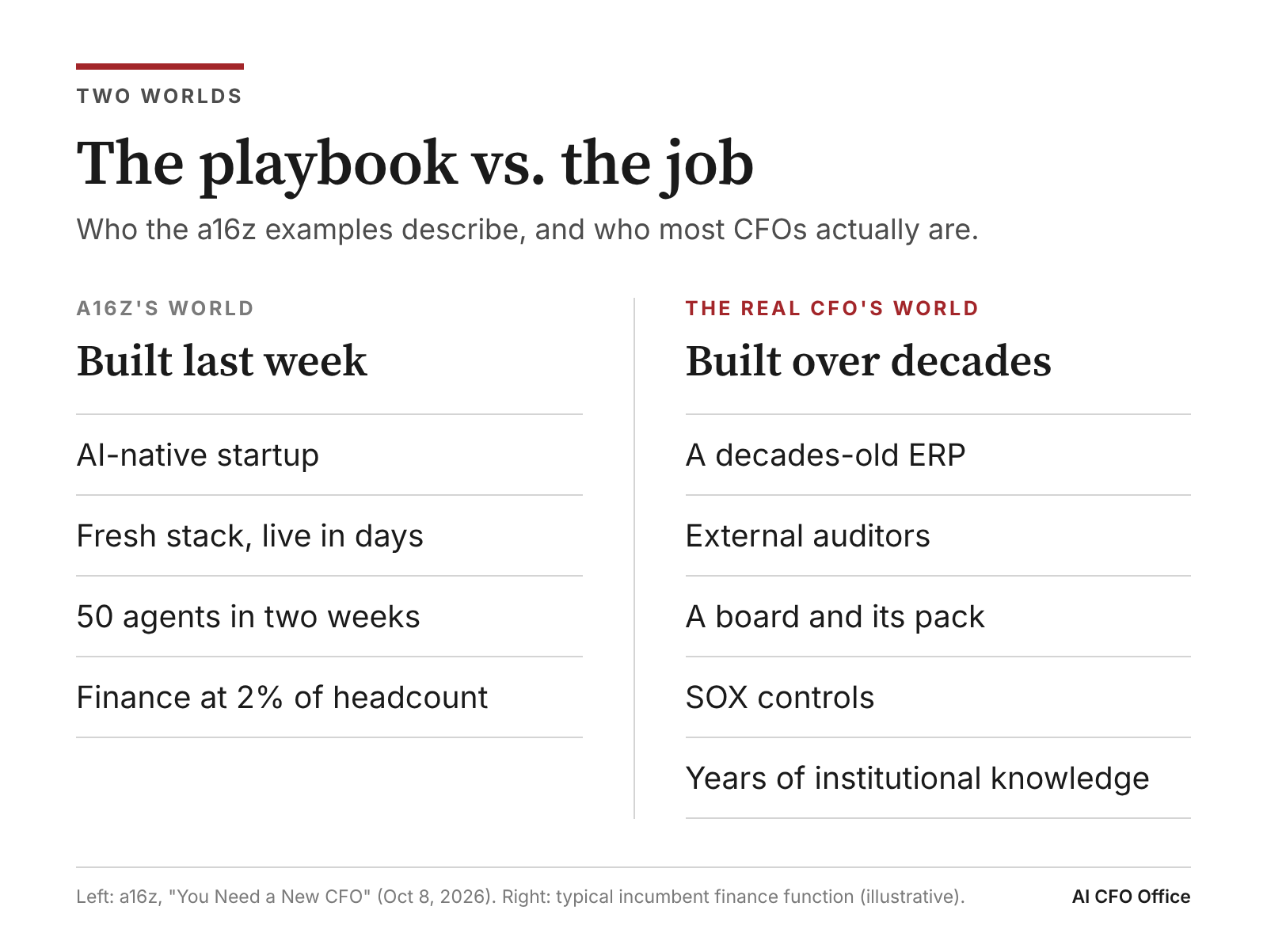
That’s fair game, and a16z labels them openly as a few examples from its portfolio. But the playbook comes from companies born on a clean stack.
Most CFOs live on an ERP older than some of their analysts, auditors who sign the opinion, a board that expects its pack every quarter, and SOX controls that took years to earn.
Your CFO holds the context
An incumbent’s greatest untapped advantage is 30 years of proprietary data, operating experience, and domain expertise.
The rule for every AI decision fits on a sticky note:
“Own the context; rent or replace the technology.”
In finance, context means knowing why one big contract gets recognized the way it does, which cost allocation the auditors pushed back on three years ago, and what the board really means by adjusted.
Your sitting CFO carries all of it.
A new hire starts at zero, and so does every agent they build.
So swap the tools freely.
Keep the person who knows what the numbers mean.
AI isn’t replacing CFOs
It’s changing what CFOs consider finance work.
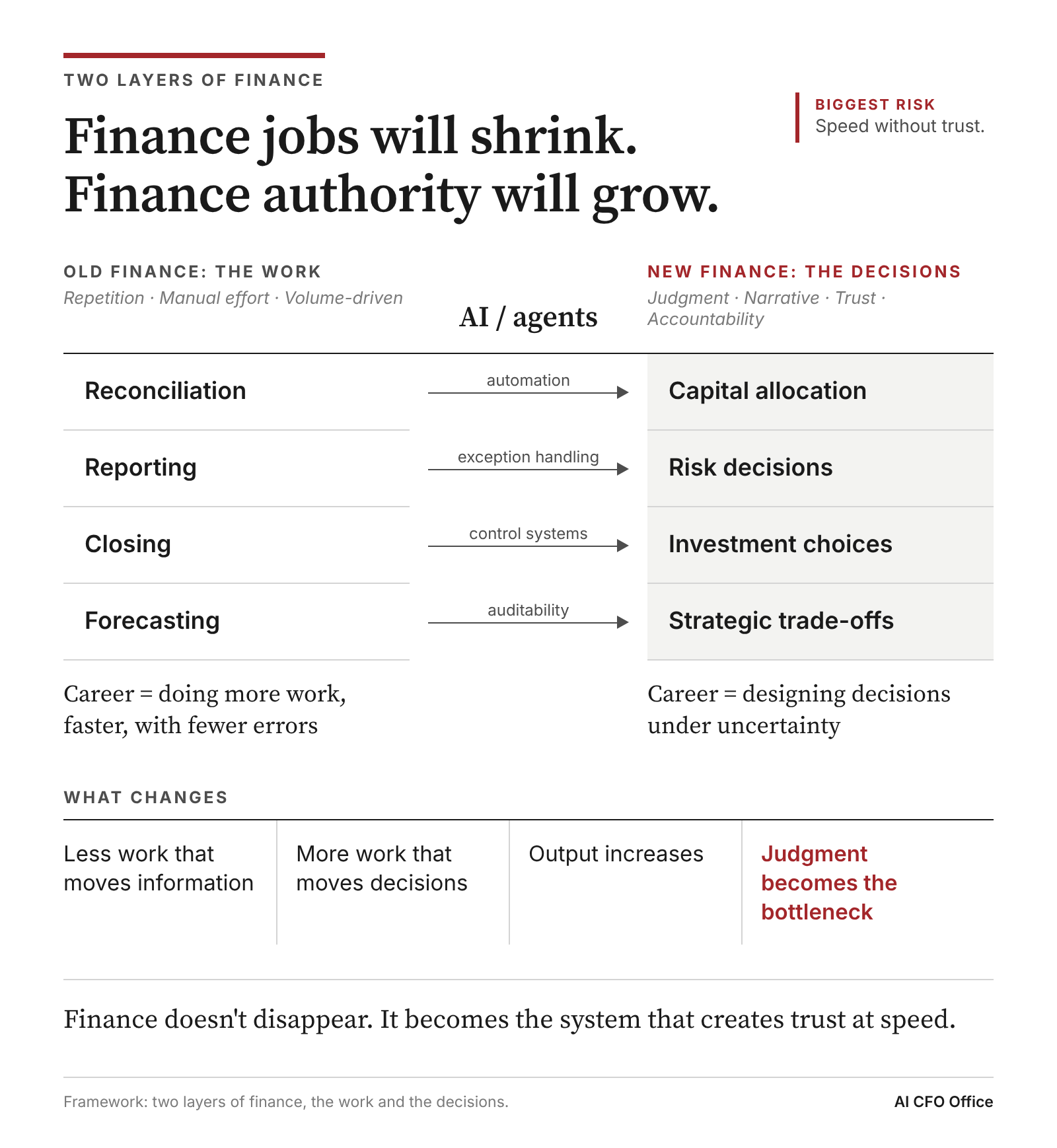
Every company runs on two layers.
Layer 1 is the work: reconciling, reporting, closing, forecasting.
Layer 2 is the decisions: where to allocate capital, how to price risk, what to cut, what to invest in.
For 30 years, the finance career ladder was built around layer 1.
You started as a doer of the work. You earned trust through repetition. You moved up by doing more volume, faster, with fewer errors.
That ladder is now being cut from the bottom.
Finance didn’t become less important. The doer layer is being eaten by agents, and what’s left is the part that mattered all along: finance as decision design.
a16z is half right here.
Right that the work layer shrinks; the leanest teams they see target finance at 2% of headcount.
Wrong that the answer is a new CFO. The decisions layer is exactly where your sitting CFO’s context and judgment live. Finance jobs will shrink in the areas built on repetition. Finance authority will grow in the areas built on judgment.
A CFO quoted by a16z warns that juniors:
“lack the experience and context to know what ‘great’ looks like.”
If the bottom rungs are gone, how does anyone earn judgment?
Use AI as the tutor, and rotate juniors into exception handling and decision work years earlier. Let them explain the variance an agent flagged, defend a call, and get corrected by someone senior.
That’s the new apprenticeship.
The story of a growth-stage CFO
a16z tells the story of a growth-stage CFO whose team built 50 agents in two weeks. Their own verdict:
“They weren’t all useful.”
A count of agents says nothing about value.
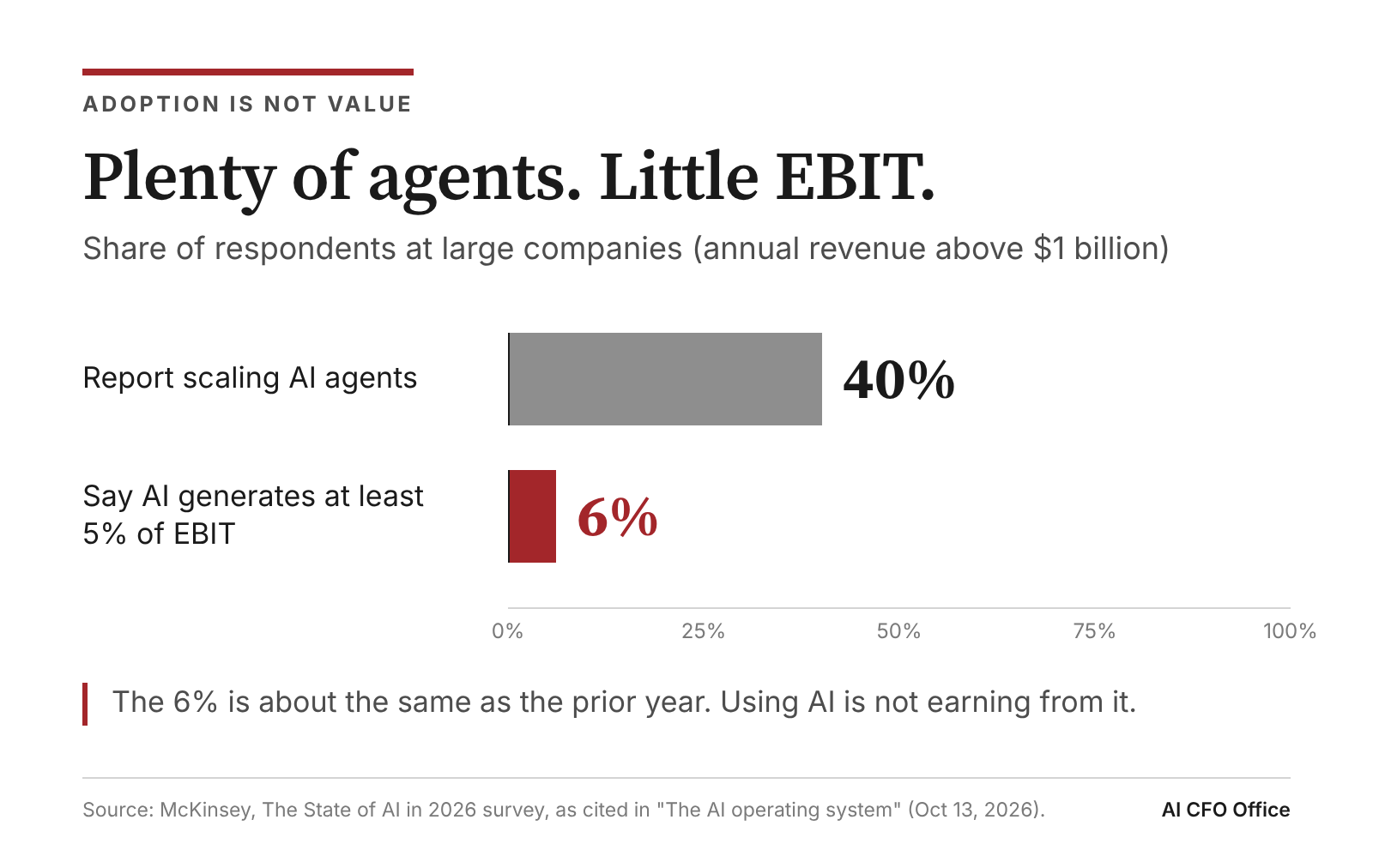
McKinsey’s 2026 State of AI survey explains why.
Among large companies (over $1 billion in revenue), 40% report scaling AI agents. Only 6% say AI generates at least 5% of EBIT, “about the same as the prior year.”
The fix is discipline.
One to three AI operating systems, not one for each use case. A finance team with 50 agents and no shared context ends up with 50 new things to reconcile.
Controls go first, not sixth
a16z lists controls sixth of seven shifts and calls them…
“a critical feature of the product.”
For a CFO, controls are the floor everything stands on.
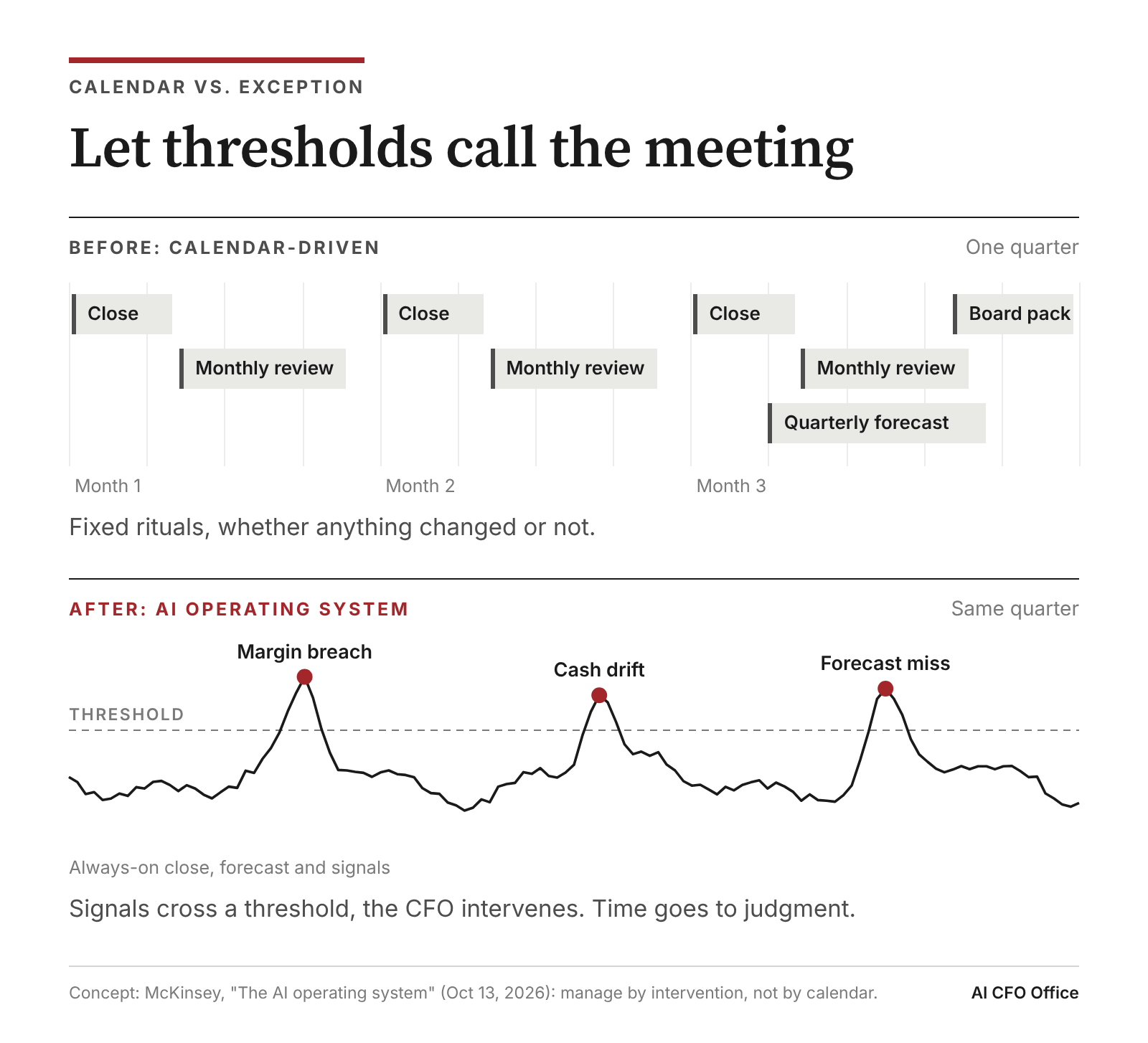
Remove the standing monthly review
McKinsey’s management shifts translate straight into finance.
Manage by intervention, not by calendar.
Remove standing reviews and define the handful of signals, thresholds, and exceptions that should trigger leadership intervention.
A margin breach or a covenant drifting toward its limit calls the meeting.
Run continuously.
McKinsey reports early deployments sped up planning cycles by up to 10x, reached first value in about 12 weeks, and cut time to ROI by 50% as the system moved into new domains.
Spend time on judgment.
An AI OS is not an executive dashboard, which reports on what has happened. Your team stops shipping numbers up the chain and starts deciding what they mean.
Token unit costs fell more than 95%, yet AI spend at many companies rose more than three times. “
The cheapest intelligence does not necessarily lower costs if lower quality creates expensive mistakes.”
Someone has to own AI economics.
That belongs with the person who already owns the P&L.
Paid subscribers: read on for the AI Operating System for CFOs, a five-layer blueprint, and the first moves I’d make this quarter.
The AI Operating System for CFOs
a16z asks you to change your CFO. McKinsey asks you to change the system. For finance, I map the architecture into five layers with a cockpit on top.