Your CEO told the board that AI will pay for itself in 6 months.
You ran the numbers, and you see 12.
You’re not alone. At AI events surveyed by the Open Future Forum, 70% of CEO-seat leaders expected payback within 6 months.
But only 42% of finance leaders agreed.
Most finance answers fell between 6 and 12 months.
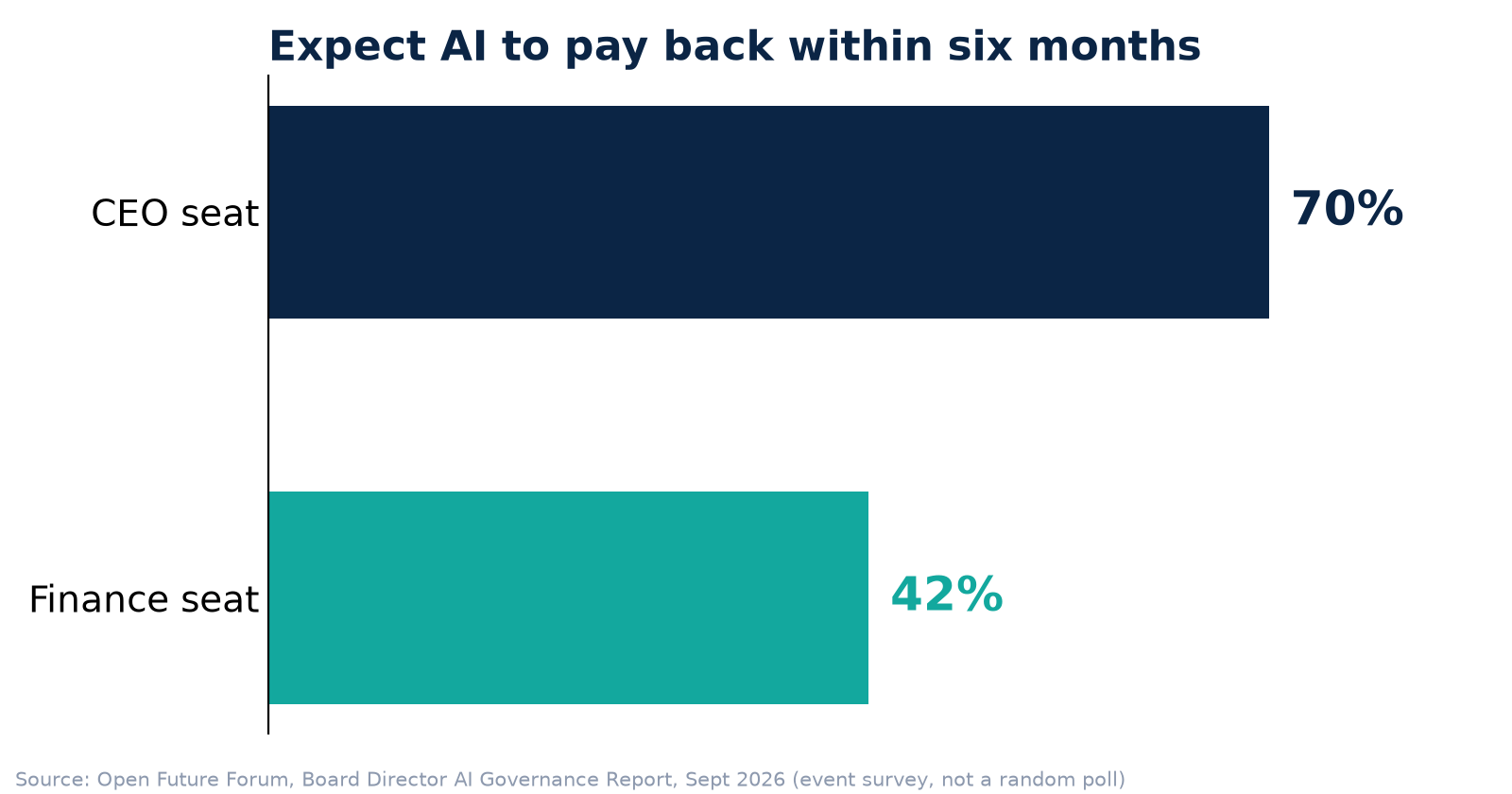
The board hears the CEO’s number. You have to prove it.
The next question is coming.
Every CFO is being asked by the board two questions.
Where is the headcount reduction?
Which specific OpEx line did this actually shrink?
Here is how to answer without calling your CEO wrong.
1. Find out why the numbers differ
Your CEO counts the day the tool works.
You count the day the saving lands in the ledger. That day comes later. The tool needs data you trust. People need to change how they work. Someone needs to check the output.
Proving the return is the top blocker. 54% of respondents name it, far ahead of integration (23%), security (21%), and data (20%) (Open Future Forum, Oct 2026).
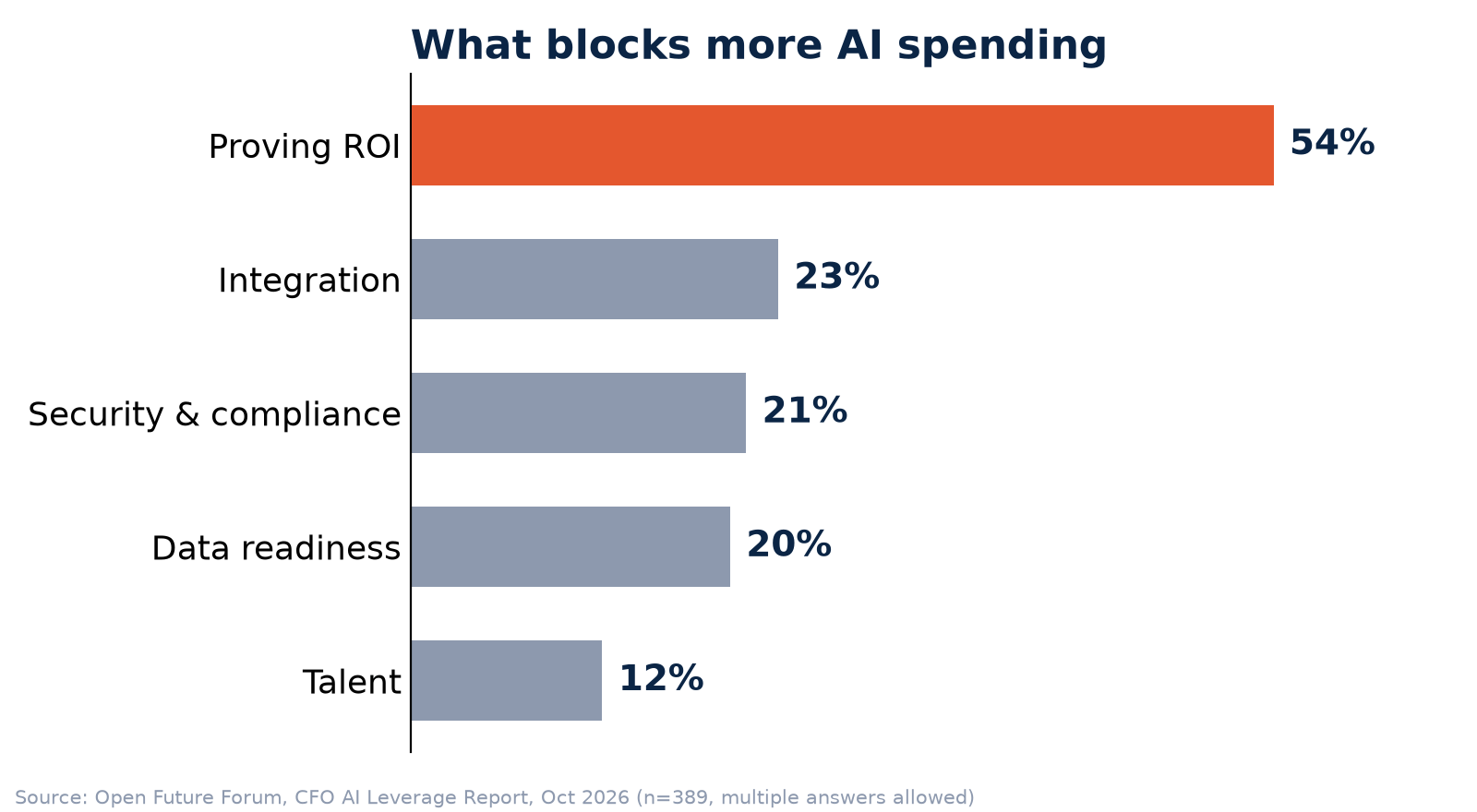
Data hurts finance most. About a third of finance respondents name data readiness as their blocker, twice the rate of the CEO seat. You cannot prove a return on numbers your team does not trust.
2. Skip the headcount shortcut
A smaller team is the fastest saving to show.
But it rarely holds.
Workforce reductions may create budget room, but they do not create return.
An FP&A professional we spoke to said. Most of their AI savings came from retooling processes and consolidating work into fewer teams. The AI played a small part.
Redesign the work first. Let headcount follow.
Give the board a line item, not a story.
The faster team does not survive a board meeting.
What survives is a named P&L line.
For every AI use, build one row:
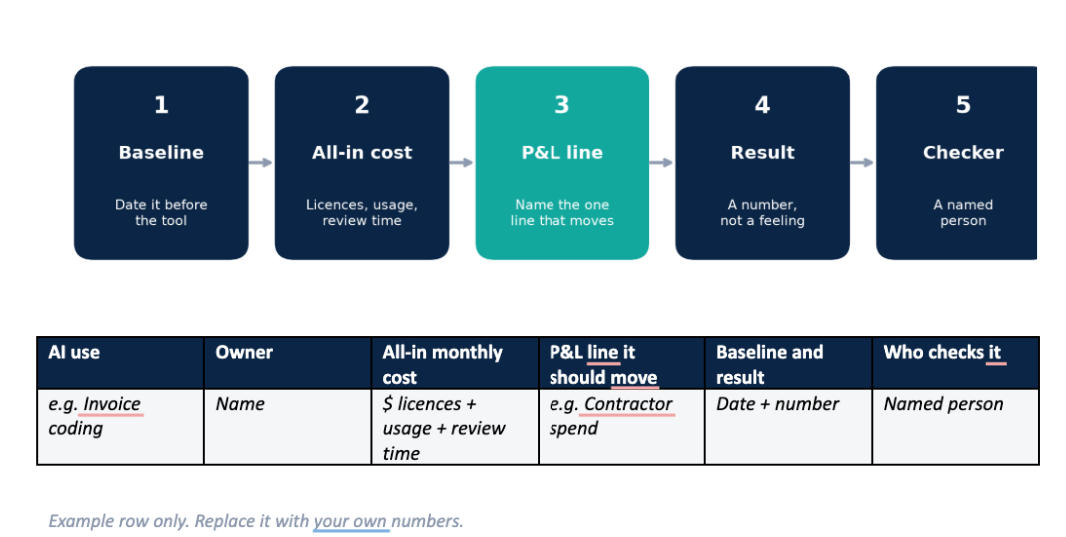
Count the real cost
Include licenses, usage, and the hours people spend reviewing output. If you cannot fill this in, you have your first finding.
Name one P&L line
Contractors, overtime, audit fees, support hours, and days to close. If no line moves, say so. Some value is real and invisible to the P&L. Say that plainly.
Date the baseline
Without a before number, you can’t prove an after.
Report a number
People like it counts as unproven.
Name the checker
Anthropic’s CFO says Claude produces the statutory statements for every legal entity. A person reviews each one.
Name one more thing: an owner. Open Future Forum asked investors what they see inside portfolio companies. Where the CEO owns AI, 9% saw nothing measurable. Where nobody owned it, 41% did.
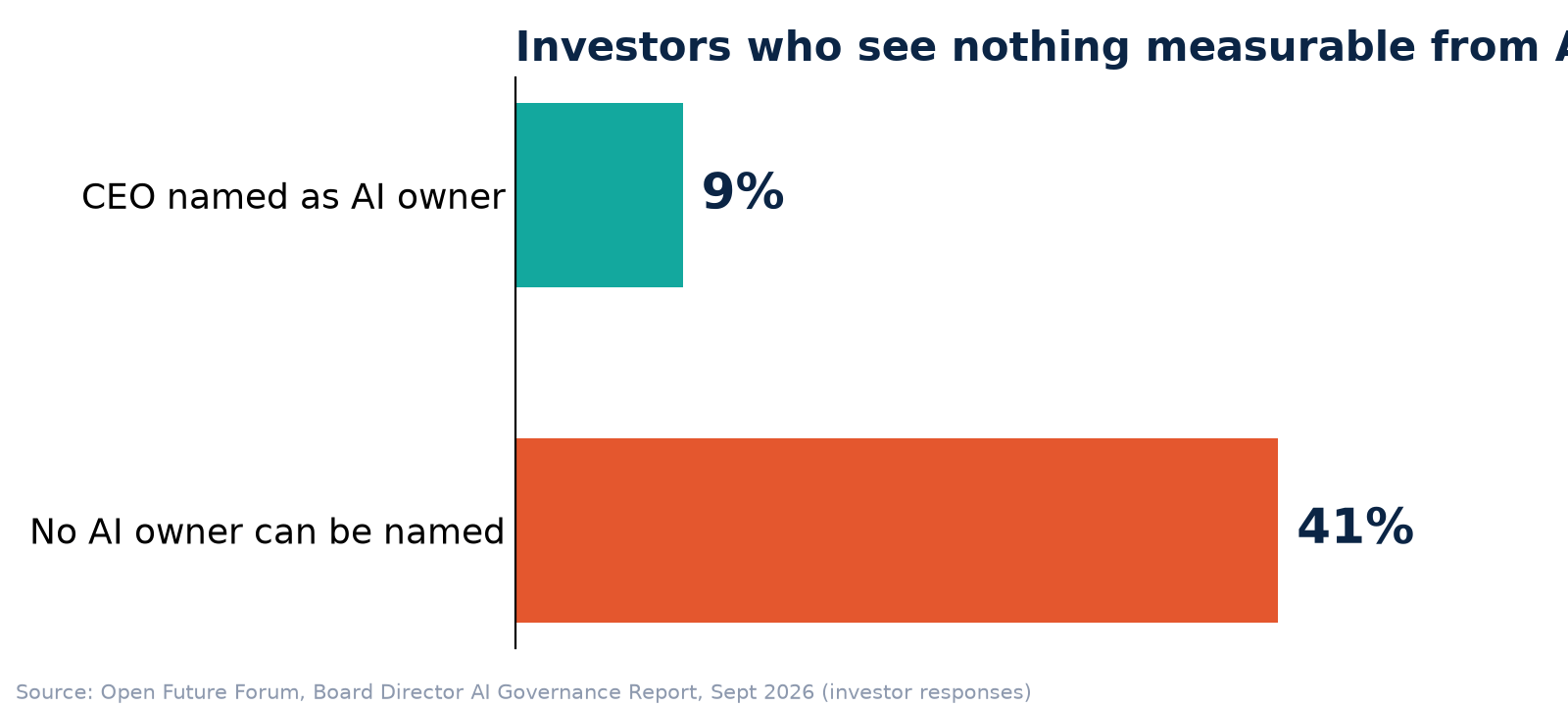
Put a name next to every row of your table.
3. Use this script with your CEO
Say it before the board asks:
“I back the AI plan. I want us to give the board a number we can hit. I mapped each use to a P&L line with a baseline. The first measurable savings land in month [X], not month six. I’d rather show the board a date we meet than one we miss. Can we walk through the table together this week?”
The script supports the strategy. It also gives your CEO a safer story for the board.
Copy what the leaders do.
Barclays announced on 1 October that Claude helps 16,000 colleagues find answers for customers and sorts 120,000 emails a day.
The bank set oversight first, then scaled.
Anthropic’s CFO, Krishna Rao, says the monthly review skill gets him 90 to 95% of the way there. His team now discusses what to do, not what happened.
Both share one pattern: controls and a named checker first, scale second.
Anthropic's CFO uses Claude for the monthly financial review. I built MFR Skill.md every CFO can install

Anthropic just went from $9 billion to over $30 billion in revenue in 4 months.
This week in finance AI
3 announcements CFOs will hear about.
IBM, 30 Sept: 62% of 1,500 CFOs now lead AI or technology strategy. Only 6% say finance is transformation-ready.
Barclays and Anthropic, 1 Oct: Claude already helps 16,000 Barclays colleagues and sorts 120,000 emails a day. Half of its developers use Claude Code by year end.
Vayu and PwC, 2 Oct: In their CFO Signal Report, 72% of CFOs call billing complexity their top operational friction point.
The Bottom Line
Pressure is high, and controls are thin.
Your board wants the return.
Your auditor wants the explanation.
You answer to both.
In a July Avalara survey, 92% of CFOs and senior finance leaders felt pressure to show an AI return. Only 44% said they were somewhat confident they could explain an AI agent’s actions to an auditor or regulator.
Close that gap this week.
Start with access.
List every AI tool with standing access to your ERP, billing system, or bank portal.
Record who approved each tool.
Set a review date for each.
Require human sign-off for anything you cannot undo, such as a new payee.
Do not fight your CEO over six months.
Hand them a better number, with a P&L line behind it, before the board asks.
And that’s all for today!
See you next week.
Whenever you’re ready, there are 2 ways I can help you:
If you have an exciting AI use case, or you have already put AI into your finance function, I’d love to see it.
I’m Wouter Born. A CFOTech investor, advisor, and founder of finstory.ai